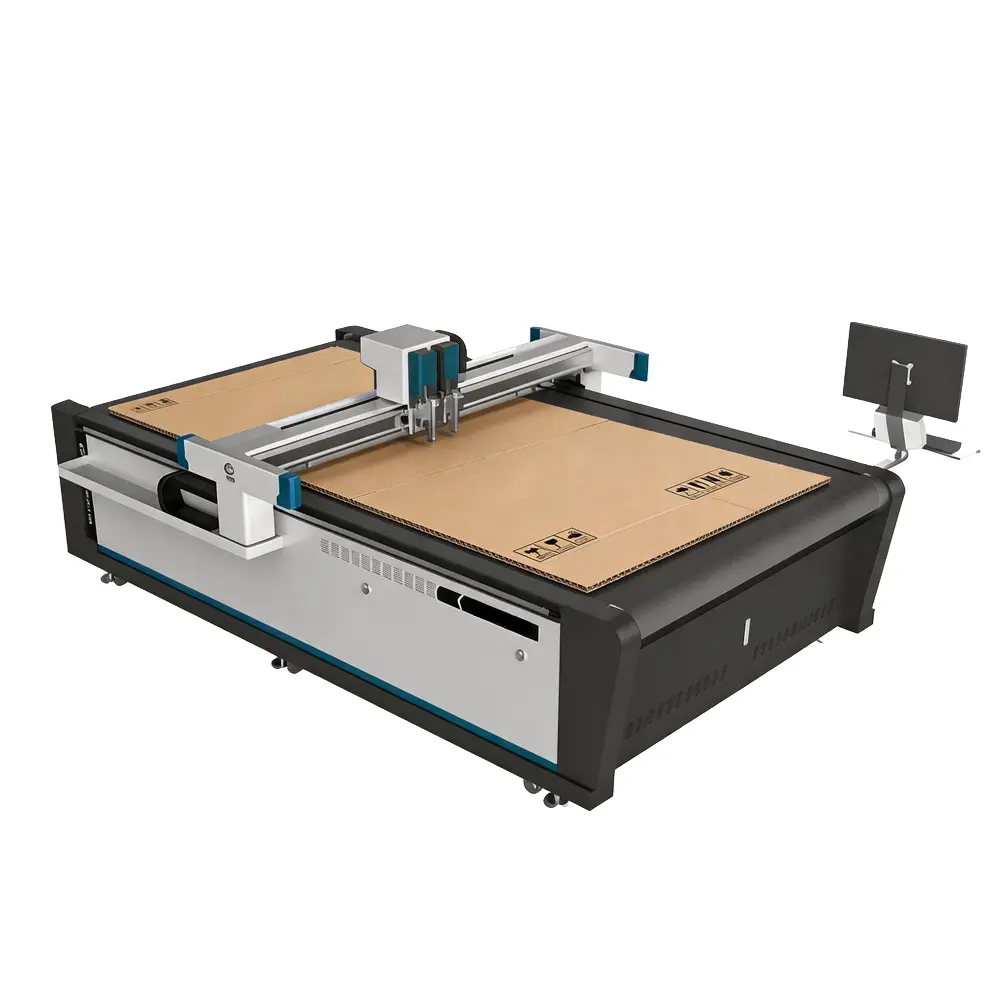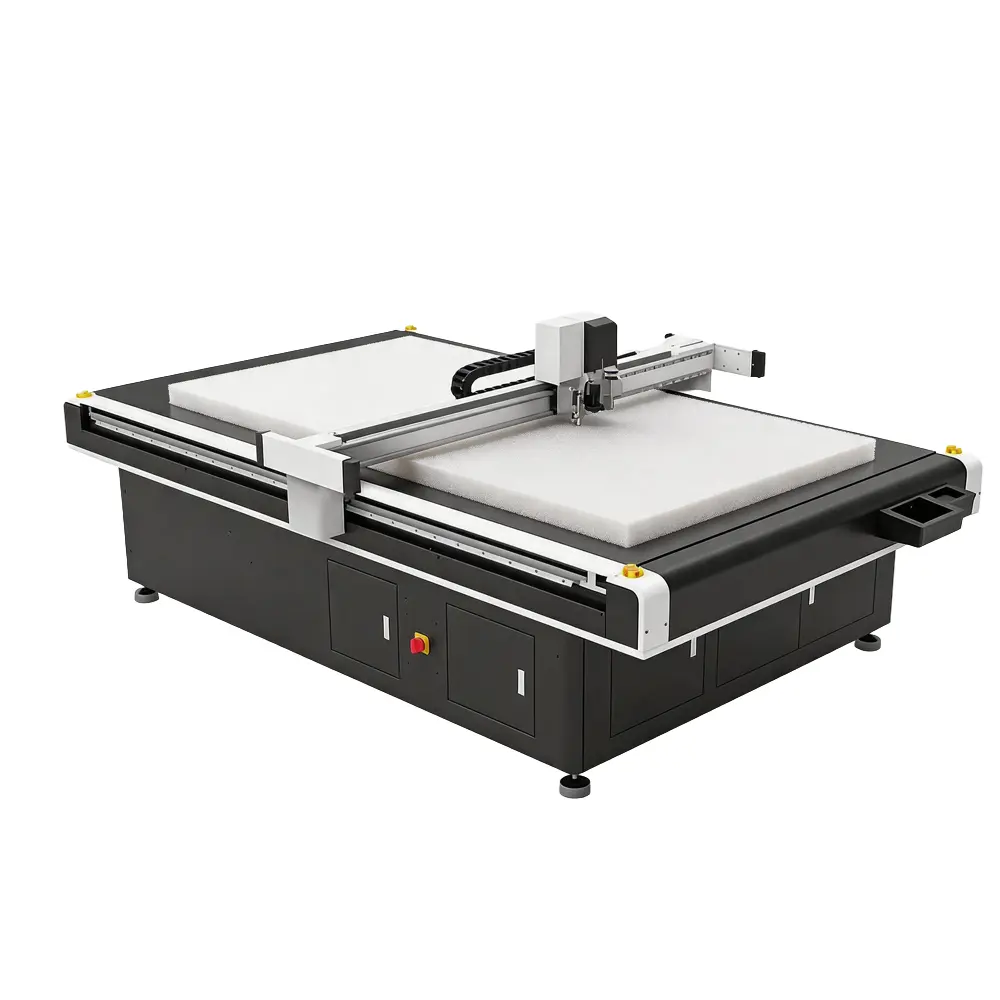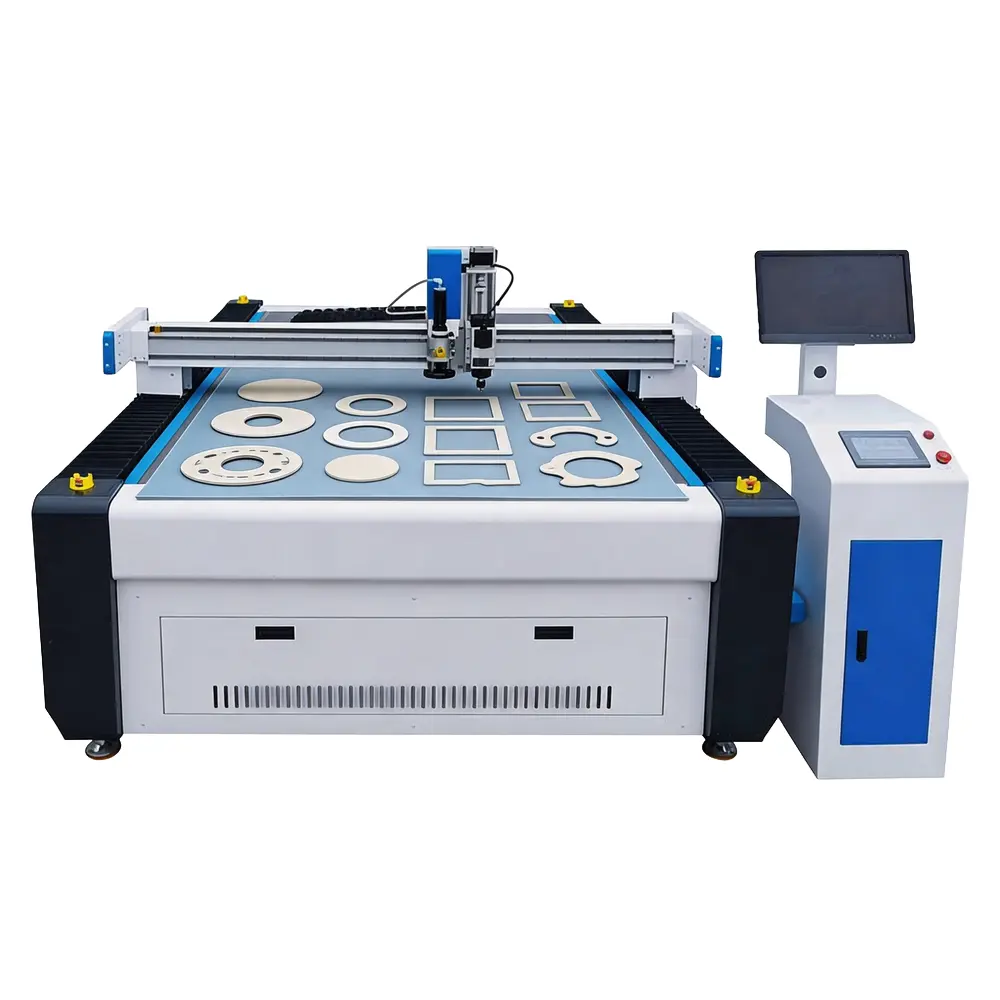
A: The key differences are as follows:
| Feature | CNC Knife Cutting (REMEYA) | Laser Cutting |
|---|---|---|
| Cutting mechanism | Physical blade (oscillating, drag, or rotary) | High‑power laser beam burning/vaporizing material |
| Edge quality | No burn marks, no melting, no discoloration | May cause brown/black burnt edges on many materials |
| Smoke & fumes | None (only minor dust from certain materials) | Significant smoke and fumes; requires extraction/filtering |
| Material suitability | Safe for PVC, vinyl, leather, foam, rubber, carbon prepreg | Cutting PVC releases toxic chlorine gas; flammable materials risk |
| Thickness range | Up to 50 mm or more (depending on knife type) | Typically limited by laser power; thick foam may melt unevenly |
| Operating cost | Low (blade replacement, occasional lubrication) | Higher (laser tube replacement, electricity, gas assist) |
| Safety | Low risk (mechanical motion) | High risk (burn, fire, eye damage) |
Recommendation: Choose REMEYA CNC knife cutting for materials sensitive to heat (leather, foam, rubber, fabrics, composites, plastics) or when clean edges without burning are required.
A: REMEYA CNC knife cutting machines are designed for a wide range of non-metallic, flexible, or semi-rigid materials, including:
Leather (natural, synthetic, bonded, automotive grade)
Fabric (woven, non-woven, technical textiles, carbon fiber prepreg, fiberglass)
Foam (polyurethane, EVA, polyethylene, neoprene, memory foam, closed‑cell foam)
Rubber (silicone, EPDM, NBR, Viton®, neoprene, thin natural rubber)
Corrugated board (single‑wall, double‑wall, microflute)
Honeycomb board (paper, plastic, aluminum honeycomb – with suitable knife)
Gasket materials (graphite, PTFE, non‑asbestos, rubber sheet, cork/rubber)
Plastic sheets (PVC, PET, PE, PP, ABS – up to moderate thickness, without melting)
Acoustic panels (PET felt, polyester fiber, melamine foam)
Paper & cardboard (folding carton, grey board, kraft paper)
Generally NOT suitable for: Thick metal plates, hard acrylic (>8 mm without routing attachment), solid wood, ceramic, or stone. However, REMEYA machines can be equipped with a small router spindle for thin, soft metals (e.g., aluminum foil or thin brass sheets).
Always consult REMEYA with your specific material and thickness – we can recommend the right knife type (oscillating, drag, or rotary) and cutting parameters.
A: Yes. REMEYA CNC knife cutting machines are compatible with leading CAD/CAM software and come with intelligent nesting software that:
Automatically arranges parts to maximize material utilization
Reduces waste by 15–30% compared to manual layout
Supports common vector formats (DXF, AI, PLT, EPS)
Allows nesting for single sheets or roll‑fed materials
Can include barcode labeling for production tracking
Popular nesting options we support: SigmaNEST, Aristo Nest, OptiNest, or REMEYA’s built‑in nesting module – you can choose based on your workflow and budget. Our training covers how to set up nesting for your specific parts and materials.
A: REMEYA CNC knife cutters support multiple interchangeable tool heads:
| Tool | Best for | Material examples |
|---|---|---|
| Oscillating knife | Thick, dense, or tough materials | Rubber, thick leather, gasket sheets, foam, corrugated board |
| Drag knife | Thin, flexible materials | Vinyl, film, paper, thin fabric, thin gasket paper |
| Rotary knife | Technical textiles, composites | Carbon fiber prepreg, aramid, fiberglass, non‑woven fabrics |
| V-cut tool | Grooving / beveling | Folding carton, foam for 3D assembly, honeycomb panels |
| Creasing wheel | Fold lines | Cardboard, corrugated board, paperboard |
| Pen marker | Marking / annotation | Part numbers, fold indicators, cut lines |
Some REMEYA models feature automatic tool change, allowing you to combine several operations (cut, crease, mark) in one job without manual intervention.
A: REMEYA knife cutters typically achieve ±0.1 mm to ±0.2 mm accuracy, depending on material and thickness. For very soft or stretchy materials (e.g., thin foam or certain fabrics), accuracy may be ±0.3 mm with proper vacuum hold‑down.
This precision ensures tight tolerances for parts that must fit together (gaskets, seals, automotive interior components, packaging inserts).
A: For thin, flexible materials (e.g., fabric, vinyl, paper), some REMEYA models can cut 2–5 layers simultaneously using a drag or oscillating knife, depending on total thickness and material compressibility.
For thicker materials (e.g., rubber sheets, foam, gasket materials), single‑layer cutting is recommended to maintain edge quality and cutting accuracy. If high throughput is needed, consider a multi‑head machine (dual or triple oscillating knives) for parallel single‑layer cutting.
A: REMEYA machines require routine but simple maintenance to ensure long‑term reliability:
| Interval | Task |
|---|---|
| Daily | Remove debris from cutting bed; check blade sharpness; clean vacuum table filters |
| Weekly | Lubricate linear rails and ball screws; inspect belts and tool holder; check dust extraction (if used) |
| Monthly | Calibrate tool height; check all electrical connections; replace worn sacrificial cutting mat (if applicable) |
| As needed | Replace dull blades immediately (signs: increased cutting noise, rough edges, material dragging) |
A maintenance log and video tutorials are provided with every machine.
A: Standard REMEYA knife cutting machines ship within 15–30 days after order confirmation. Customized machines (special table size, multi‑head, or unique tooling) typically require 30–45 days.
We handle all shipping arrangements (sea, air, or land). Installation and operator training take 2–3 days on‑site. Remote training is also available for certain regions.
A: They are used across many industries where precision cutting of soft or composite materials is required:
| Industry | Applications |
|---|---|
| Automotive | Interior trim (leather, fabric, foam), headliners, gaskets, sound insulation |
| Aerospace | Carbon prepreg cutting for composite parts, sealing gaskets, insulation blankets |
| Packaging | Corrugated box samples, foam inserts, honeycomb packaging, custom displays |
| Furniture & bedding | Mattress foam, upholstery fabric, leather cutting for sofas |
| Textile & garment | Fabric cutting for apparel, technical textiles, non‑woven materials |
| Gasket & seal manufacturing | Rubber, PTFE, graphite, non‑asbestos sheet cutting (die‑less) |
| Sign & display | Vinyl, foam board, corrugated plastic, magnetic sheets |
| Medical | Foam padding, soft medical textiles, silicone gaskets |
A: REMEYA CNC knife cutting offers several advantages over traditional die cutting:
| Aspect | Die Cutting | REMEYA CNC Knife Cutting |
|---|---|---|
| Tooling cost | High (steel rule die per design) | Zero (digital files only) |
| Lead time | Days to weeks (die manufacturing) | Minutes to hours (file upload) |
| Design changes | Expensive and slow | Instant, free |
| Waste | Fixed layout, often inefficient | Nesting optimizes material usage |
| Minimum order quantity | High (spread die cost over volume) | Very low (even 1 part) |
| Material thickness flexibility | Limited (die works best at fixed thickness) | Wide range (adjust knife depth) |
Conclusion: For low‑to‑medium volume production, prototyping, frequent design changes, or multiple material thicknesses, a REMEYA knife cutting machine is far more economical and flexible than die cutting. For extremely high‑volume (millions of parts) with fixed designs, dies may still be cost‑effective.

Before starting to use our service, please fill in the form, to tellus what CNC Knife Cutting Machine you want to import from China.