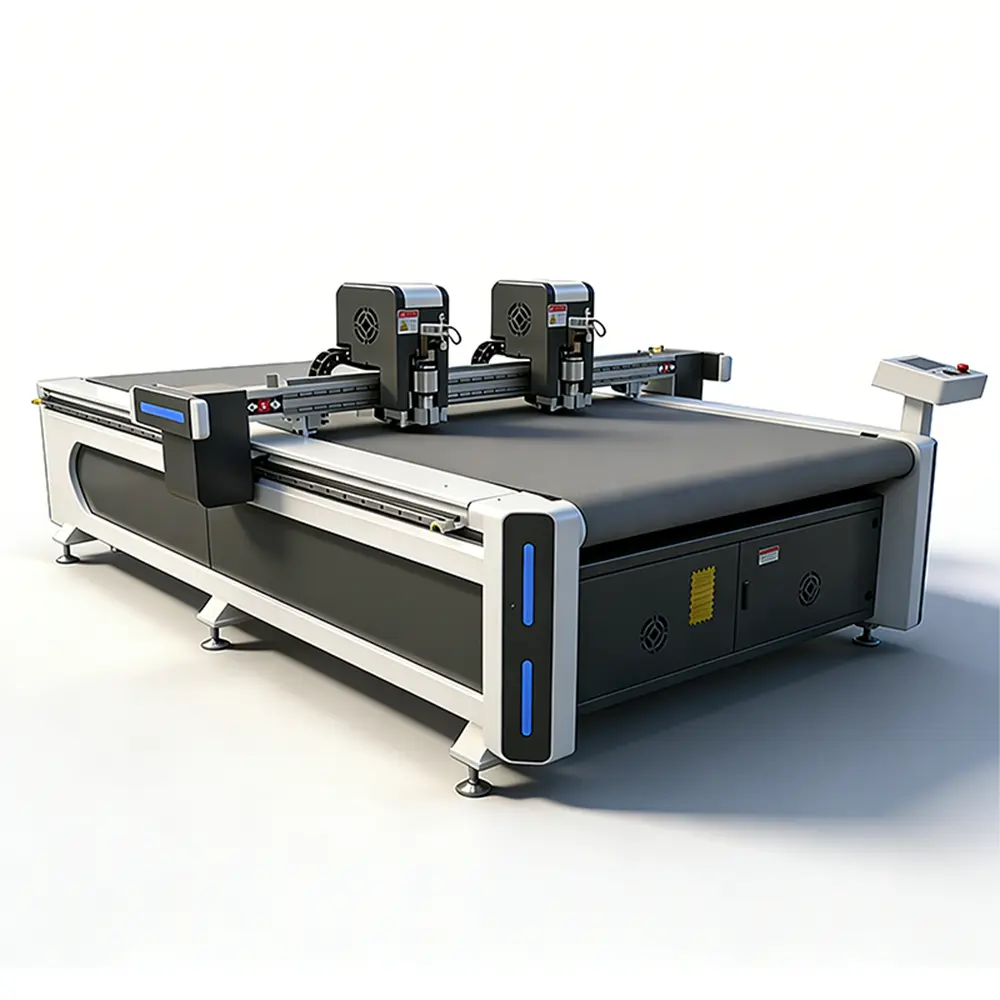
Cutting PET felt, polyester fiber, and other acoustic panels – without fraying, without burning, without wasted time.
We’ve talked to dozens of acoustic panel makers. Most start with hand cutting or a basic knife. That works for one-off samples. But when orders grow to hundreds of sheets per week, edges get messy, shapes drift, and your best people spend all day on simple rectangles.
REMEYA’s acoustic panel cutters use an oscillating blade – no laser, no router. Just a sharp knife moving up and down very fast. It slices through PET felt, polyester fiber, melamine foam, and similar materials. Clean edges. No melt. No dust cloud.
You feed in a CAD file. The machine does the rest: cut, V‑groove, punch holes, even cut logos. One setup. Same result on panel #1 and panel #1000.
Give us your typical panel size, thickness range, and a few photos of your current cut quality. We’ll send back a machine recommendation and a factory price.
REMEYA offers CNC acoustic panel cutting machines equipped with oscillating knife, V-cutting and punching tools, optimized for PET felt and polyester fiber acoustic panels.
From standard PET felt panel cutters to bevel slotting systems, each model is designed to support clean cuts, accurate grooves and high production efficiency.
Think of it as a plotter – but with a knife that moves up and down 12,000 times per minute. Instead of a pen drawing lines, the knife cuts through soft acoustic materials.
You design any shape in Illustrator, AutoCAD, or even free CAD software. Circles, hexagons, wavy edges, slots, perforation arrays. The machine follows the lines exactly.
No templates. No tracing. No re‑cutting because the first one came out wrong.
The cutting bed has a vacuum system. It pulls the panel flat so nothing shifts during cutting. For thick or springy materials like high‑density PET felt, the knife automatically adjusts its depth and angle.
Materials we see every day in our customers’ shops:
PET felt from 3 mm to 50 mm thick (1200–2200 g/m² density)
Polyester fiber acoustic boards (soft and semi‑rigid)
Melamine foam (the white or grey open‑cell stuff)
Recycled cotton or denim insulation panels
Thin non‑woven backing fabrics for acoustic composite panels
No burn marks. Lasers melt edges on PET felt. The smell is bad, and the hard melted edge can affect sound absorption. Our knife just cuts – cold.
No dust. Routers throw fiber dust everywhere. You need expensive dust collectors. Knife cutting produces almost zero dust. Your workshop stays cleaner, and you don’t worry about breathing fiber particles.
No fraying. A hand knife or a cheap oscillating machine can tear the top layer while leaving bottom fibers uncut. Our knife speed and downforce are tuned specifically for felt and fiber panels. The edge looks sealed, even under magnification.
One machine does three jobs. Most shops cut shapes on one table, then move panels to a separate grooving machine for V‑folds, then drill holes by hand. Our machine puts all three steps in one program. Load sheet. Press start. Unload finished parts.
Less waste. The software nests parts automatically – tetris for acoustic panels. We’ve seen customers go from 75% material utilization to 88% just by switching from manual layout to our nesting algorithm. That adds up fast when PET felt costs $15–40 per sheet.
Acoustic panels are not like plywood or acrylic. They compress, shift, and sometimes leave fuzzy edges if the tool isn’t right. So we added specific features:
Pressure foot with spring suspension – Holds the material down right around the blade, so thick felt doesn’t lift while cutting curves.
Real‑time knife compensation – For panels thicker than 20 mm, the machine leans the blade slightly to keep vertical walls. No tapered edges.
Quick‑change tool holders – Switch from oscillating knife to V‑groove tool or drag knife in under 30 seconds. No wrench needed.
Vacuum zones – You can turn on only the area under your panel, so smaller sheets still hold flat without losing suction around the edges.
Remote job upload – Design team in the office sends a cut file to the shop floor machine over Wi‑Fi. Production doesn’t wait for USB drives.
Office ceiling baffles, Korea – A manufacturer switched from waterjet cutting (slow, messy) to REMEYA A5. They now cut 220 baffles per shift, each with four V‑grooves for folding. Edge quality improved, and material cost dropped 12% because nesting fit more parts per sheet.
Recording studio wall panels, California – The client needed 600 hexagon panels from 30 mm PET felt, each with a 2‑mm perforation pattern on two sides. Hand cutting was taking three weeks. REMEYA did it in four days. No fraying inside the small holes.
Retail logo wall, Dubai – A design firm wanted a 4‑meter wide backlit acoustic panel with cut‑out brand letters. They tried a local CNC router – letters looked rough. Our oscillating knife cut the same letters cleanly, even through 25 mm felt. No sanding required.
School acoustic clouds, Germany – 800 cloud shapes, each with a hanging hole pattern. The customer needed every hole identical so suspension cables align. Their previous hot‑wire cutting gave inconsistent hole sizes. REMEYA’s punch tool solved it.
Q: Can your machine cut perforation patterns for acoustic tuning?
A: Yes. We’ve done round holes from 1 mm to 15 mm, slots, staggered patterns, and variable hole density across a single panel. The machine reads your CAD pattern and punches or cuts each hole. Speed depends on hole count – about 2‑3 seconds per hole for 5 mm holes in 20 mm PET felt.
Q: What about very thin panels – like 3 mm PET felt?
A: Thin panels need a drag knife instead of an oscillating knife. The drag knife works like a vinyl cutter. We include both tools. The machine detects which you have loaded.
Q: Do I need special software?
A: You design in whatever CAD you already use (AutoCAD, Illustrator, SolidWorks, Fusion 360). Our free nesting software converts your file to cut paths. No license fee.
Q: How long does a knife blade last?
A: Typical blade life on PET felt: 600–1000 linear meters, depending on density. Blades are standard industrial oscillating blades – about $8–12 each. You can buy them anywhere, not just from us.
Q: Training – do you send someone to our shop?
A: We can, but most customers learn online. We send you a training video package and schedule three remote live sessions. The first session covers machine setup. The second covers software and file prep. The third is a live cut of one of your own panel designs. After that, you’re running on your own. On‑site training is extra but available.
Q: What’s the warranty?
A: Two years on the machine frame and motion system. One year on electronics and the oscillating knife motor. Consumables (blades, hold‑down foam) are not covered, obviously.
What makes REMEYA different? Before we ever designed our first acoustic panel cutter, we ran our own cutting service for acoustic panel makers. For three years we processed real customer orders every day — PET felt, polyester fiber, melamine foam, you name it.
That hands-on work taught us exactly what breaks, what frustrates operators, and which material combinations cause trouble. When we finally started building our own machines, we didn’t guess — we solved the problems we had lived with.
When we finally started building our own cutters, we designed them to solve the problems we saw every day.
Operators hated changing vacuum zones? We made a one‑button automatic zone selector.
Felt fibers wrapping around the knife holder? We redesigned the holder with a fiber‑shedding coating.
Software crashes losing jobs? We simplified the controller to run on a hardened tablet, not a Windows PC full of background processes.
Today, REMEYA machines run in 14 countries. Most of our new customers come from referrals. And every machine we sell is still supported by the same engineers who built it – not a call center reading a script.
We’re based in Jinan, same as many CNC manufacturers. But we don’t compete on price alone. We compete on knowing acoustic materials better.
Send us an email. Tell us:
Your monthly sheet volume (approximate)
Panel thickness and material (PET felt density, if known)
One or two photos of your current cut edge quality
We’ll reply within 24 hours with:
A model recommendation (A3, A5, or A7)
A factory price – no dealer markup
A sample cut file and instructions to test our software with your own design (no machine needed)
If you want, we can run a remote demo: you watch our machine cut your panel design live over video call.

Before starting to use our service, please fill in the form, to tellus what CNC Knife Cutting Machine you want to import from China.