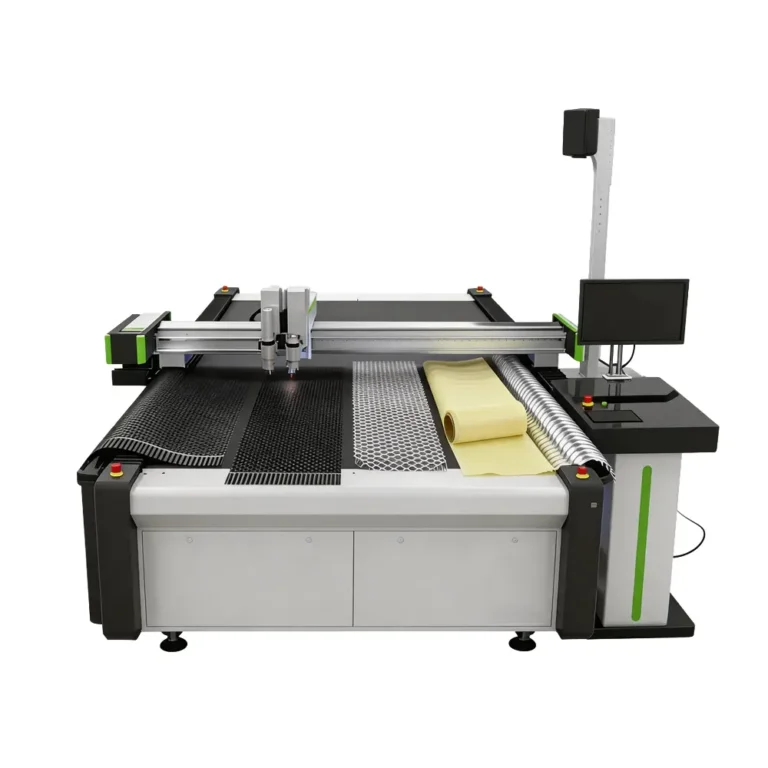
Cutting composites like carbon fiber, fiberglass, aramid, phenolic board, and insulation panels is demanding — fibers fray easily, dust must be controlled, and patterns must stay accurate under high production pressure.
REMEYA composite material cutting machines combine CNC oscillating knife technology, intelligent nesting software, and powerful drive systems to process dry fabrics, prepregs, and rigid panels — delivering clean edges, stable quality, and high material yield.
Whether you serve aerospace, automotive, marine, wind energy, or HVAC ducting, our cutting machines help reduce manual work, improve material utilization, and bring digital precision to your production floor.
Share your material type, layer structure, and production targets with our team — we will provide a tailored CNC composite material cutting machine solution directly from REMEYA factory.
We offer dedicated composite cutting machine models for dry fabrics, sticky prepregs, rigid insulation boards, and phenolic duct panels — so you can match the machine to your primary material and process.
From large-format fiberglass cutting tables to specialized prepreg and aramid cutting machines, each model is engineered by REMEYA to handle the specific challenges of its target material while maximizing yield and throughput.
In simple terms, a composite material cutting machine is a CNC machine that uses a fast-moving knife to cut through tough materials like carbon fiber, fiberglass, aramid, phenolic board, and insulation panels. You feed it digital patterns, and it cuts exactly those shapes.
This isn’t like using scissors or a box cutter. The oscillating knife moves up and down thousands of times per minute—think of an electric carving knife on steroids. Combined with servo motors and a vacuum table that holds the material flat, it cuts clean edges without heat, dust, or fraying. That’s a big deal because composites don’t like heat. Lasers can char the edges and weaken the fiber structure. Routers create dust and can delaminate layers. The oscillating knife just slices.
So what does that mean for a factory floor? You replace manual cutting—which is slow, inconsistent, and wastes material—with a digital process. You get higher throughput, less scrap, and every part comes out the same. For industries like aerospace or automotive, that repeatability isn’t just nice; it’s required.
Not every cutting machine handles all composites well. Here’s what our machines are built for:
Dry fabrics – carbon fiber, fiberglass, basalt, aramid, and blended fabrics. These are used in everything from boat hulls to wind turbine blades. The challenge? They fray easily if the blade isn’t sharp or the oscillation isn’t dialed in right.
Prepregs – these are fabrics pre-impregnated with resin. They’re sticky, tacky, and expensive. Cutting them requires clean blades and the right speed, or resin builds up and ruins the cut edge.
Insulation and duct boards – phenolic board, PIR/PUR foam, fiberglass wool, mineral wool, rock wool. These are messy. Dust is a real problem. That’s why we design our machines with dust control in mind and offer V-cutting tools for folding ductwork.
Technical textiles and foams – things like rubber foam, acoustic liners, thermal insulation layers. Often used in cars, trains, and buildings.
Boron and silicon carbide fibers – these are the high-end stuff. Very stiff, very expensive, used in aerospace and defense. Our heavier-duty models can handle them.
Let’s get straight to what matters: less waste, cleaner cuts, fewer people standing around with scissors.
Clean, fray‑free edges – The oscillating knife doesn’t tear the fibers. It slices them. With serrated blades for aramid and straight blades for carbon prepreg, you get edges that don’t need trimming or sanding.
You save material – sometimes a lot – Our nesting software isn’t just basic pattern arrangement. It looks at fiber direction, roll width, and part shapes, then figures out the most efficient layout. On expensive materials like carbon fiber (which can cost hundreds of dollars per square meter), that 8–15% savings adds up fast.
Parts come out the same, every time – CNC control means your tenth part matches your thousandth. That ±0.1mm accuracy matters when you’re bonding parts together or meeting aerospace specs.
One machine does the work of several people – Automated feeding, cutting, and marking means one operator can run the machine while doing other tasks. Customers often tell us they replaced four manual cutters with one REMEYA machine.
Less dust in the air – Oscillating knife cutting creates far less dust than routers or saws. Add our optional HEPA extraction system, and you capture fines down to 0.3 microns. That’s cleaner air for your workers and less fire risk from carbon fiber dust.
Quick changeover between materials – Switch from dry fabric to prepreg to foam in minutes. You don’t need new tooling. That’s useful if you run a job shop or do prototyping alongside production.
Runs 24/7 – Brushless servo motors don’t overheat. The machine can keep cutting overnight. That’s real productivity.
Connects to your factory system – We support standard file formats and can integrate with your ERP or CAD workflow. Nothing fancy, just what works.
Here are the technical bits that actually make a difference on the shop floor:
Oscillating knife heads – Different blades for different jobs. Straight blades for clean cuts on prepregs. Serrated blades for aramid and Kevlar (which loves to fray). You swap them in seconds.
Vacuum table – Holds material flat without clamps. Multiple zones let you cut on one side while unloading the other.
Intelligent nesting software – Like we said: greedy algorithms and genetic algorithms working together to pack parts tight. It’s not magic, but it works.
Conveyor or flatbed – Conveyor version lets one person feed and unload continuously. Flatbed is better for rigid boards.
Marking tools – Inkjet, labels, or even a pen for marking ply IDs, fold lines, or assembly marks. Helps the layup team know what’s what.
Strong frame – Heavy cast-aluminum and linear rails. Nothing flexes when the knife is oscillating at 5000 strokes per minute. That’s how we hold ±0.1mm.
Tool flexibility – Beyond knives, you can add a drag knife for thin materials, a creasing wheel, or a marking pen. One machine, multiple jobs.
The short answer: anywhere people cut expensive composite materials and care about quality and waste. More specifically:
Aerospace & motorsport – Think carbon prepreg for interior panels, wing components, and race car bodies. Tolerances are tight, materials are pricey. Our machines handle both dry fabric and tacky prepreg, and the nesting software saves enough material to pay for the machine over time.
Automotive & transportation – Glass fiber and carbon for body panels, truck interiors, EV battery covers. Lightweighting is the name of the game. Consistent cuts mean parts fit better in assembly, and less rework.
Marine & wind energy – Big parts. Fiberglass rolls up to 3 meters wide. Our conveyor machines can cut boat hull plies or wind turbine blade fabrics in one pass. Nesting helps cut waste on large patterns.
HVAC ducting & insulation – Phenolic boards and insulation wool. The V-cutting tool creates fold lines for ductwork. Dust extraction keeps the shop clean. Simple and effective.
Protective equipment – Aramid and Kevlar for vests, helmets, cut-resistant sleeves. These fibers are tough on blades. Our serrated blade strategy keeps cuts clean without fraying.
Electronics & construction – Things like radomes, antenna covers, structural reinforcements. Not the biggest volume, but the same precision requirements apply.
Q: Can one machine cut both dry fabric and sticky prepreg?
A: Yes, with the right blade and settings. Dry fabric likes a serrated blade. Prepreg (tacky, resin-coated) likes a sharp straight blade. We can set up a machine that handles both—or if you mostly cut one type, we optimize it for that. Tell us your material mix, and we’ll recommend a configuration.
Q: How do you control dust with insulation and composites?
A: Two ways. First, oscillating knife cutting itself produces much less dust than routers or saws. Second, we offer an optional dust extraction system with HEPA H14 filters—that’s 99.995% efficient down to 0.3 microns. It pulls dust right from the cutting head. For really sensitive environments, we also have fully enclosed cutting stations.
Q: How much material can nesting actually save?
A: It depends on your parts. But typical numbers: rectangular parts go from about 72% utilization to 86%. Curved parts from 68% to 82%. On carbon fiber that costs $100+ per square meter, that’s serious money. The software also respects fiber direction, so you don’t accidentally ruin the structural properties just to save material.
Q: How accurate are these machines?
A: ±0.1mm under normal conditions. That’s about the thickness of a sheet of paper. For aerospace parts that need even tighter, we have high-precision options.
Q: What kind of support and training do you provide?
A: We train your operators on blade selection, speed settings, nesting strategies, and daily cleaning and maintenance. Online or on-site—your choice. After that, we provide ongoing support as you add new materials or change production processes. We also help you set up maintenance schedules so the machine keeps running 24/7.
Q: Why oscillating knife instead of laser or waterjet?
A: Lasers generate heat. Heat chars carbon fiber and can delaminate aramid. Waterjet is messy—you have water disposal, drying, and sometimes abrasive cleanup. Oscillating knife is dry, clean, and fast for materials up to about 50mm thick. For what most composite shops cut, it’s the sweet spot. No heat damage, no water mess, minimal dust.
Q: What thickness can you cut?
A: Up to about 50mm (2 inches) depending on material density. Thicker than that, you might need a different method. But most prepregs, dry fabrics, and insulation boards are well within that range.
Q: Do I need compressed air?
A: No. The oscillating knife is electromechanical. Just plug it in.
We’re not the only company making CNC cutting machines. But we’ve been doing it long enough — REMEYA has been engineering and supporting these machines for years — to know what actually breaks, what frustrates operators, and what saves money.
We work directly with factories like yours. Not through distributors. That means when you call, you talk to people who know how to tune a blade for sticky prepreg or fix a vacuum zone issue. The machine is engineered, assembled, and supported by one team.
Our customers in aerospace, automotive, marine, and HVAC stay with us because the machines run reliably, the nesting software actually works, and we’re responsive when they need help.
You’re cutting carbon fiber, fiberglass, aramid, phenolic board, or insulation? We’ve built machines for that. We can build one for you.
Give us your material types, layer counts, and rough production volume. We’ll send back a machine recommendation, a configuration, and a price. No fluff. Just what you need to cut cleaner, faster, and cheaper.
Contact REMEYA today.

Before starting to use our service, please fill in the form, to tellus what CNC Knife Cutting Machine you want to import from China.