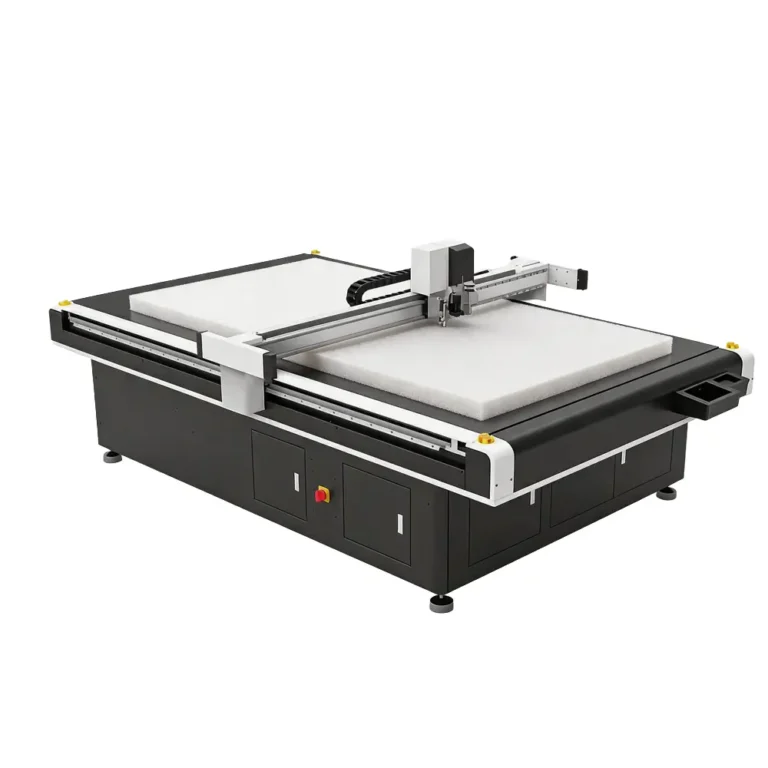
We talk to packaging shops every week who still cut EVA foam with a utility knife and a paper template. The edges come out compressed. Pocket depths vary from one insert to the next. And material waste runs 15–20% higher than it should.
REMEYA CNC foam cutters replace hand cutting and steel‑die pressing with an oscillating knife that slices through foam instead of crushing it. You load a CAD file, choose the tool, and the machine cuts profiles, pockets, strap slots, and even debossed logos into EVA, EPE, XPE, EPS, XPS, PU foam, sponge, EPDM, and neoprene. Edges stay vertical. Dimensions stay repeatable. And you can change the design ten minutes before production without waiting for a new die.
Tell us your typical foam type, thickness range (up to 100 mm for knife cutting, deeper with optional milling), and weekly volume. We will recommend a machine configuration that fits your floor space and budget.
REMEYA provides a range of CNC foam cutting machine configurations designed for soft foams, rigid foams, and technical foam applications—handling everything from straightforward profiles to intricate pockets and three-dimensional shapes.
Every model integrates oscillating knife cutting, optional milling capability, and intelligent control systems to deliver precise, efficient foam processing in your production environment.
Closed‑cell foams like EVA and EPE cut cleanly with high‑frequency oscillation. The blade moves up and down 4,000–6,000 times per minute, making thousands of tiny cuts per second. Each foam cell separates without tearing its neighbors.
Open‑cell foams (sponge, PU for acoustic panels) require sharper blade engagement and slower feed rates. Otherwise the tool pulls the material instead of cutting it.
Rigid foams (EPS, XPS, high‑density PU) sometimes need a spindle mill for deep pockets and chamfered edges. Knife cutting works for profiles up to moderate thickness, but once you need a recess deeper than 30 mm in XPS, a 2.2 kW milling spindle does a cleaner job in one pass.
Our standard oscillating knife handles most cushioning and gasket foams up to 60 mm. For technical foam jobs involving stepped pockets or 3D contours, we add a spindle as an optional second tool on the same gantry.
Forget hot wires that melt foam and leave a hard, burned crust on EPS. Forget routers that throw fine dust into every bearing and motor connection. A CNC foam cutting machine uses a sharp blade oscillating at high frequency. The blade never gets hotter than room temperature. No fumes. Almost no dust.
You design the part in any CAD software — SolidWorks, AutoCAD, Fusion 360, even a 2D DXF from a customer’s email. Our nesting software (included) lays out as many parts as possible on each foam sheet. The machine cuts the first part exactly the same as the hundredth part. If a customer changes a gasket’s inner diameter from 25 mm to 27 mm, you edit the file and cut again. No die modification. No tooling cost.
Many of our customers run mixed batches: ten tool box inserts, then fifty EPDM gaskets for an HVAC supplier, then five foam mounting pads for a medical device. The machine switches between jobs in the time it takes to load the next foam sheet.
EVA foam (density 30–150 kg/m³): tool case inserts, playing mat components, shoe insoles, fitness equipment padding.
EPE (expanded polyethylene): void fill, dunnage, protective corners, fragile electronics packaging.
XPE cross‑linked foam: automotive interior trims, sports protective gear, yoga blocks.
EPP (expanded polypropylene): reusable packaging trays, automotive bumpers, child safety seats.
PU polyurethane (soft): furniture cushion cores, mattress overlays, acoustic foam wedges.
EPS / XPS (rigid): architectural study models, insulation panels, signage letters, floral foam blocks.
EPDM / neoprene / silicone foam: weather seals, vibration isolation pads, gaskets for electrical enclosures.
Sponge / reticulated foam: filter media, aquarium sump foam, backing for sanding pads.
If you cut laminated foam (adhesive‑backed EVA on a carrier, or foam bonded to fabric), the same machine works. We just adjust blade depth and oscillation frequency to go through both layers cleanly.
No more crushed edges.
A hand‑cut EVA insert looks fuzzy and compressed along the cut line. That compressed foam no longer cushions properly. Our oscillating knife leaves a smooth, vertical wall. The cell structure stays open, so the insert performs as designed.
One machine handles short runs and high mix.
Steel rule die tooling costs 300–300–1,500 per design, plus a week of lead time. If a customer changes a pocket dimension, you pay for a new die. With a dieless CNC foam cutter, design changes cost zero dollars. You can profitably run a batch of five custom camera inserts in the morning and a batch of five hundred gaskets in the afternoon.
Less foam waste pays for the machine.
Manual layout typically achieves 60–70% material utilization. Our nesting software regularly reaches 85–90% on rectangular foam sheets. For a shop cutting 500 sheets of EVA per month, that 20% reduction in scrap adds up to thousands of dollars saved annually.
Cleaner shop, happier staff.
Hot wire EPS cutting generates styrene fumes. Routers create fine dust that settles everywhere. Our knife systems produce minimal particulate and zero smoke. Operators stop cleaning bearings every week and start cutting more parts.
Protective case inserts – Tool kits, rifle cases, drone transport cases, medical instrument boxes. Pluck foam is cheap but looks unprofessional. CNC‑cut EVA with custom logos and stepped pockets sells to premium brands.
Automotive and industrial gaskets – EPDM foam seals for battery boxes, compressor housings, and HVAC access panels. The machine cuts internal holes, mounting bolt clearances, and perimeter shapes in one cycle.
Acoustic and insulation parts – EPS blocks for architectural models, XPS insulation for cold storage doors, acoustic foam panels for recording studios. Milling spindles add surface textures and chamfers that knife cutting alone cannot create.
Furniture and bedding – PU foam cushion cores for sofas, memory foam topper layers cut exactly to mattress dimensions. Replace band sawing and hand trimming with a digital file.
Sports and medical padding – EVA foam knee brace liners, wheelchair seat cushions, crash pad inserts for climbing gyms. Symmetrical left/right parts cut perfectly mirrored from the same file.
A: Oscillating knife cutting works reliably up to 100 mm for most soft and medium‑density foams (EVA, EPE, PU). For EPS or XPS blocks thicker than 150 mm, we recommend a different blade geometry or a hot wire cutter, depending on your edge quality requirements. Contact us with your exact thickness and foam type.
A: Yes. The knife head uses air pressure to maintain downforce and retract the blade between cuts. Typical requirement is 80–100 psi, 6–8 cfm. We include the regulator and solenoid valves with the machine.
A: Direct imports from .dxf, .dwg, .ai, and .pdf. For 3D milling toolpaths, we work with .stp, .igs, or .3mf files. The software runs on a standard Windows PC connected to the machine via Ethernet.
A: Most operators learn basic cutting within two days, including file preparation, tool changes, and maintenance. We offer remote training via Zoom or on‑site training at your facility (travel costs apply). After training, you get phone and email support with typical response under 24 hours.
A: Yes, but we recommend a blade coating option (Teflon‑like) and a lower oscillation frequency. Sticky foam residue builds up faster than on bare foam. We show you a cleaning routine using isopropyl alcohol and a soft brush – takes 30 seconds every two hours of cutting.
A: An optional automatic surface sensor probes the foam height before cutting and adjusts the knife penetration depth on the fly. Without the sensor, you must ensure foam sheets lie flat (vacuum table holds them down, but extreme warping still causes problems). For cheap, wavy foam, we recommend running a surface scan or planing the top layer with a spindle first.
We are the factory – Jinan REMEYA Technology Co., Ltd., based in Shandong, shipping worldwide. You are not buying from a trading company that adds a margin and forwards emails. You work directly with our engineers.
Each foam cutting machine comes assembled and tested on our floor. We cut test parts from your sample foam (send us a piece) and include the cutting parameters in the machine’s library. Delivery typically takes 25–35 working days depending on options (conveyor, multiple tool heads, dust extraction).
We provide:
One‑year warranty on mechanical parts, two years on the controller.
Spare blades, oscillation drive belts, and linear bearings in stock.
Remote troubleshooting via AnyDesk.
Optional on‑site installation and training for larger production lines.
Send us photos of your current foam parts – good and bad. Tell us the material name, thickness, and weekly quantity. Also let us know which problem bothers you most: edge quality, scrap waste, changeover time, or labor cost.
We will reply with a recommended machine model, tool configuration, and a factory‑direct price. No generic quotes. No pressure. Just a solution that actually works for your foam shop.

Before starting to use our service, please fill in the form, to tellus what CNC Knife Cutting Machine you want to import from China.