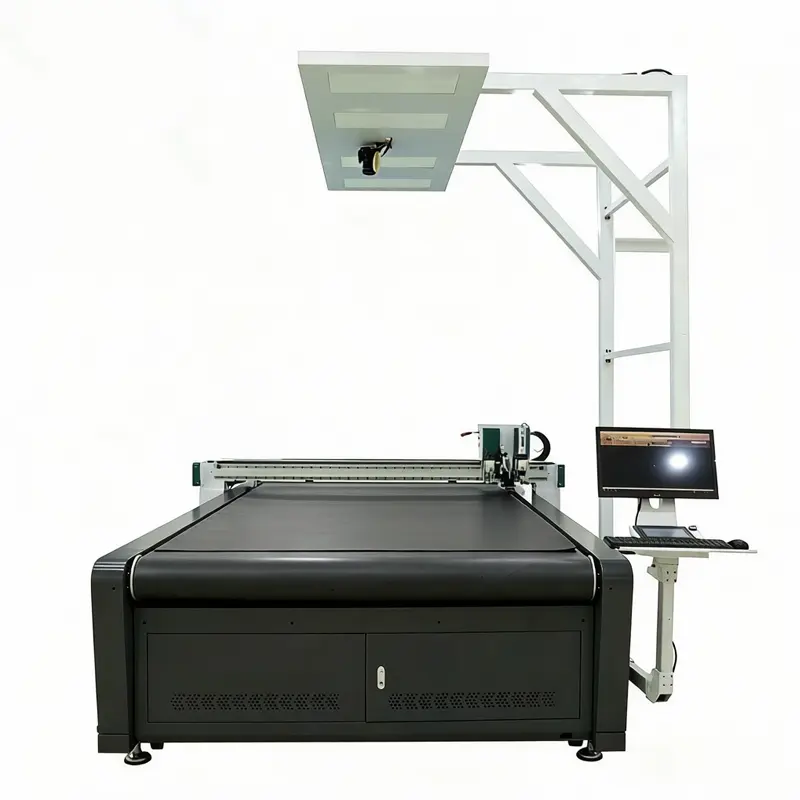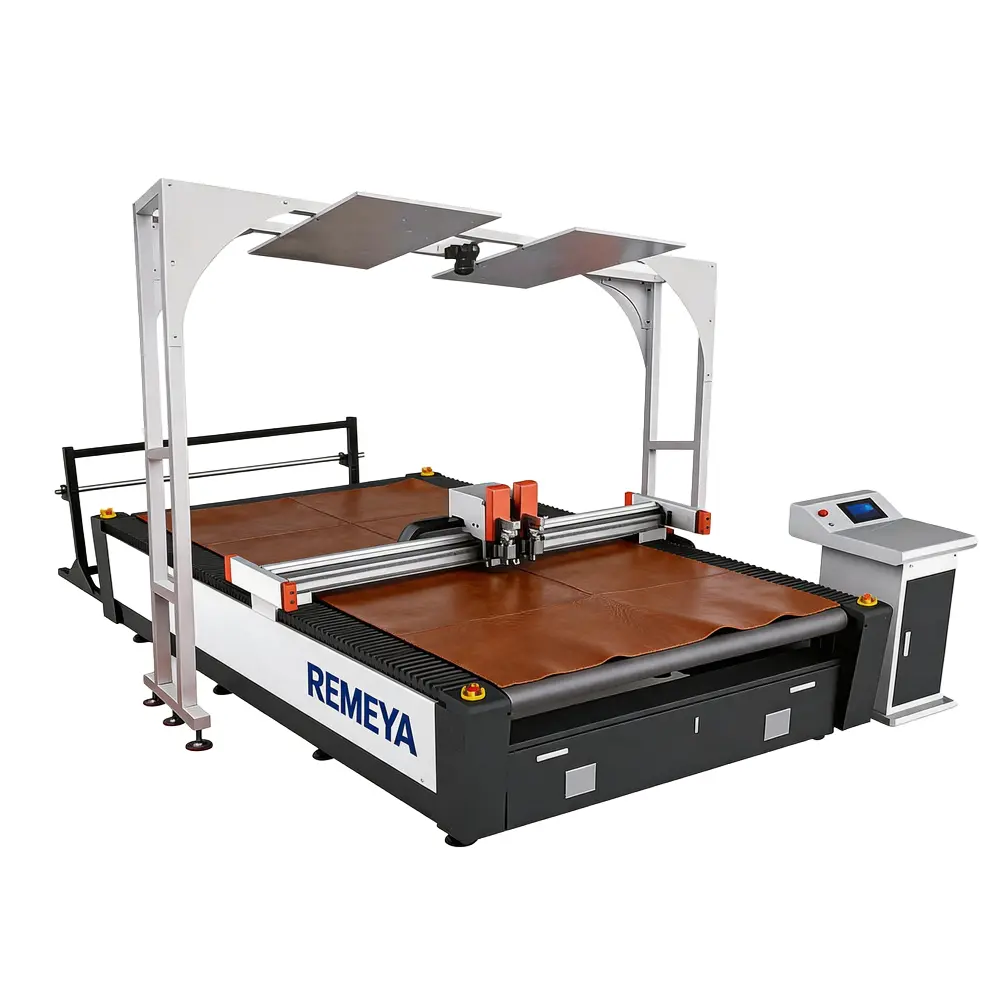
Cutting leather for car seats, sofas, sneakers, and handbags is never just about following a line. One hide might have a scar in the middle; another might stretch unevenly near the belly. Traditional die cutting ignores all that – you stamp the same shape regardless of defects. Manual cutting relies on a skilled worker’s eyes and steady hands, which are getting harder to find and keep.
REMEYA’s approach is different. We build CNC cutters that see each hide as unique. The machine photographs every piece, finds the flaws, then arranges your patterns around them – automatically. Then an oscillating knife cuts through genuine leather, synthetic microfiber, or foam-backed composites at speeds and precision that manual methods can’t match.
No steel dies. No burnt edges. No smoke in the workshop.
If you are running a leather workshop – whether automotive interiors, upholstery, footwear, or bags – tell us what materials you cut, what products you make, and roughly how many hides per day. We will suggest a machine layout that fits your floor space and production rhythm.
We keep our model range simple because too many choices confuse more than they help. You basically need to decide: flatbed or conveyor-fed? Single head or dual? How much surface area per cut?
A CNC leather cutter is essentially a robot that holds a knife. You feed it a digital pattern – DXF from your CAD software, or even a scanned paper template – and the machine moves the blade along the lines. But two things make leather cutting different from cutting metal or plastic.
First, leather is not uniform. A cowhide has a spine, belly, shoulder, and legs. The thickness, stretch, and grain vary across the hide. A good CNC system must allow you to set different cutting pressures for different zones, or the knife might cut too deep on the belly and too shallow on the spine.
Second, hides have defects – brands, scratches, insect bites, fat wrinkles, holes. A die press stamps right through them. A manual cutter might avoid them but wastes time and gets tired. A CNC cutter with a vision system can see the defects and move the patterns around them automatically.
That is the core difference: digital nesting guided by vision. Without vision, a CNC cutter is just a faster way to do what a manual cutter does. With vision, you start saving material – typically 12% to 18% compared to manual nesting, and 20% to 25% compared to die cutting (because dies can’t avoid defects at all).
One thing we get asked often: can it cut fur? Yes, but you need a serrated blade and you cut from the back side (flesh side) so the fur fibers aren’t damaged.
One thing we get asked often: can it cut fur? Yes, but you need a serrated blade and you cut from the back side (flesh side) so the fur fibers aren’t damaged.
1. Oscillating knife cutting head with optional creasing, punching and marking tools – multi‑process in one setup
The cutting head isn’t just for cutting. You can swap in a creasing wheel to mark fold lines, a punching tool for holes or slots, or a marking pen to write part numbers or alignment marks. All without moving the material to another machine. For example: cut a car seat panel, crease the stitch guide line, punch a hole for a headrest clip, and mark the batch ID – all in the same cycle. This cuts down handling time and eliminates misalignment from moving half‑finished parts between stations. For furniture or bag makers who used to run three separate operations, this single‑setup approach can cut total processing time by 30% or more.
2. Vision camera system – captures hide shape, marks defects, and nests around flaws
Before cutting starts, a high‑resolution camera scans each hide. It maps the exact outline and automatically identifies natural defects – scars, tick marks, fat wrinkles, holes, even color variations. The system treats these as no‑cut zones. Then the nesting engine arranges your patterns so they avoid those bad spots, while keeping the best leather for visible panels (like a sofa arm or a handbag front). You can also add manual defect markers on the touchscreen if the camera misses something subtle – the software respects those too. The result: you waste less leather because you no longer cut around defects with oversized safety margins, and you stop quality rejects from hidden flaws showing up on finished products.
3. Intelligent nesting software – optimizes pattern layout by yield, matching, grain direction, and batch
The nesting software does more than just pack shapes tightly. It lets you set priorities. Want maximum material savings? The software runs a yield‑first calculation. Need all left and right shoe panels to come from matching hide areas? Turn on symmetrical pairing. Working on a premium car interior where grain direction must flow the same across all seats? Lock the grain orientation. Also useful for batch processing: the software can group patterns from the same order, so you cut everything for one sofa set or one bag batch together, avoiding mix‑ups later. You can even save different nesting recipes for the same pattern – one for high‑yield, one for visual quality – and switch depending on the customer’s price tier.
4. Flatbed and conveyor feeding options – handles sheets, hides, rolls, and multi‑layer cutting
Choose the feeding style that matches how you work. A flatbed (stationary table) is simple and affordable – load one hide, cut, unload. Good for smaller volumes or large, irregular pieces. A conveyor system moves material continuously: place hides or rolls at the front, the belt feeds them under the cutting head, and finished pieces come out the back. This keeps the operator feeding while the machine cuts, with no idle waiting. For synthetic leather rolls, the conveyor can cut multiple layers stacked on top of each other – up to six layers of PU, PVC, or microfiber. And you are not locked in; some factories keep a flatbed for sampling and a conveyor for production, using the same software on both.
5. User‑friendly control interface – works with common CAD formats and connects to your ERP
The control software does not require special training in proprietary file types. It reads standard formats: DXF, AI, HPGL, even scanned PDFs or images. Drag and drop your pattern files, set cutting parameters (speed, oscillation frequency, vacuum pressure), and the machine is ready. For production management, the system logs every cut – which patterns, how many pieces, which hide ID, yield percentage, and cycle time. That data can be exported to Excel or pushed directly to your ERP/MES via a simple API or CSV output. Production supervisors can see live or end‑of‑shift reports without walking to the machine. This is not an afterthought; we built the data logging so you can track material usage, operator performance, and blade wear without extra manual paperwork.
We could list fifty features, but most are marketing noise. Here are the ones that matter when you run the machine eight hours a day.
A Tier‑1 supplier in Thailand cuts seat covers for a Japanese car brand. They used to send hides to a subcontractor with a die press. The subcontractor could not avoid defects, so the rejection rate was 8%. After installing a REMEYA X‑Conveyor with vision nesting, they brought cutting in-house. Rejection dropped to 1.5%. Yield per hide went up 14%. Payback was eleven months.
What makes automotive special: grain matching. The patterns for a seat have to look like they came from the same part of the hide. The nesting software can enforce that – all front panels from the spine, all back panels from the shoulder.
An Italian sofa maker cuts whole hides for recliner covers. Their challenge is pattern matching across multiple pieces that will be sewn together. If the grain direction is wrong, the finished sofa looks patchy. The REMEYA nesting module includes a “grain lock” function – patterns rotate but only within a range you set. The machine also remembers which hide supplied which piece, so if a later piece is missing, you know exactly where to cut another.
A factory in Vietnam making sports sandals switched from manual cutting to a REMEYA M‑Flatbed for their PU straps. Straps are long, narrow pieces. Manual cutting wasted a lot of leather between straps. The nesting software reduced waste by 22% just by tilting the straps at angles that fit the hide better. Also, symmetrical pairs are cut from adjacent areas of the hide so left and right straps age the same way.
A workshop in India makes handbags for export. They have hundreds of SKUs – different sizes, colors, hardware. With die cutting, each SKU needed its own die set. Inventory of dies filled a room. Now they keep only digital files. When a buyer orders 200 pieces of a discontinued model, they just open the old file and cut. No die waiting period, no storage cost.
Leather jackets require very clean edges because the raw edge is often visible on the inside of the jacket. Laser cutting leaves a brown line. Knife cutting leaves a clean beige line (for natural leather). Also, gloves have small, complex parts – fingers, palms, reinforcements. Vision nesting packs dozens of small parts onto a single hide with very little waste.
It depends on pattern shape and hide quality. Based on our customer data (over 300 installations):
The biggest gains come from cutting around defects automatically. Manual cutters tend to avoid defects by cutting around them with a big margin. The machine leaves a much tighter margin – sometimes 3 mm instead of 20 mm.
On synthetic leather (PU, PVC, microfiber), yes – up to 6 layers depending on thickness. The knife oscillates through all layers, and the vacuum holds the stack down. On natural leather, we do not recommend multi-layer because each hide has different thickness and stretch. The top piece might shift relative to the bottom. For natural leather, one layer at a time gives better accuracy.
For genuine leather, one oscillating blade typically lasts 8–12 hours of continuous cutting. For synthetic leather (which is more abrasive), about 4–6 hours. Blades are inexpensive – a few dollars each. The machine has a blade wear counter. You set a limit (say, 10 hours) and the machine reminds you to change. Also, you can flip the blade to use the other corner.
Vacuum filters need cleaning daily – takes two minutes. The belt on conveyor models should be checked monthly; typical life is 1–2 years depending on how often you cut through it by accident (yes, it happens).
We do both. Most common issues – software settings, blade alignment, vacuum problems – we can solve remotely via a video call. We have remote access to the machine control PC (with your permission). For hardware failures like a servo motor or a vacuum pump, we ship spare parts and send a technician if needed. Our response time for remote support is usually within 4 hours during working days.
Send us samples. We run a free cutting test on your materials and your pattern files. You get a video of the cut, a report of cycle time per piece, and a yield estimate. No obligation. Many customers send ten different leather types before they decide. That is fine – we would rather you be sure than guess wrong.
We are not the biggest, and we do not try to be. What we are is focused. We only build cutting machines for leather, fabric, foam, and composites – flexible materials. We do not make routers for metal or lasers for acrylic. That narrow focus means our engineers have handled almost every weird leather problem: how to cut salted hides (clean the salt first), how to cut wet-blue leather (slower oscillation, lower vacuum), how to cut very stretchy lambskin (use a drag knife instead of oscillating).
Our machines are designed by people who spent years on leather factory floors. The software has shortcuts that manual cutters appreciate – like “add 2mm seam allowance to all selected edges” in one click, or “duplicate pattern and mirror for opposite side”.
We also do not lock you into proprietary formats. You can export from any CAD software – even Inkscape or a scanned PDF. The machine imports DXF, AI, HPGL, and a few others. You are never forced to buy extra software.
Pricing is factory-direct. No distributor margin. That typically makes us 15–20% lower than comparable European or American brands, with similar or better build quality (we use Bosch servos, SMC pneumatics, and German-made guide rails).
Here is what we need to give you a useful recommendation:
Send to our engineering team via the contact form on the REMEYA site. You will get a reply within one business day – usually with a specific model suggestion, an estimated yield gain, and a rough budget number.
We also offer online factory tours (live video walkthrough) so you can see the assembly line and ask questions in real time. No slideshows, no pre‑recorded videos – just a real engineer walking through the workshop with a phone camera

Before starting to use our service, please fill in the form, to tellus what CNC Knife Cutting Machine you want to import from China.