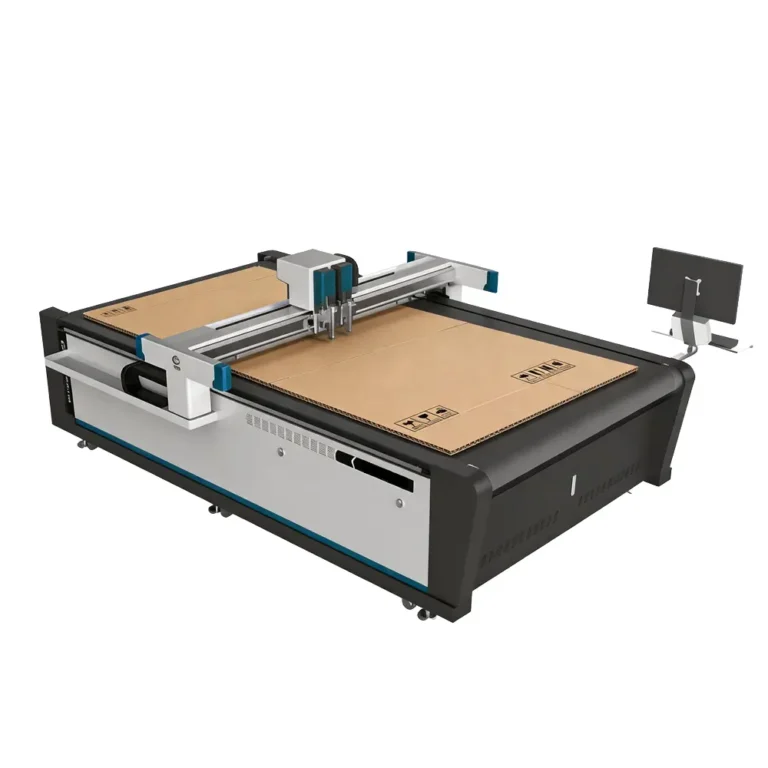
Digital cardboard cutting machine removes the need for traditional steel‑rule dies. You send a CAD file, the machine cuts the shape, presses the fold lines, and marks the material – all in one pass. Samples, short runs, custom boxes, and point‑of‑purchase displays become as fast as your design team can work. No tooling delays, no die costs, no minimum quantities.
REMEYA’s flatbed cardboard cutting machine handles folding carton board, single‑wall and double‑wall corrugated, honeycomb panels, and greyboard. It uses an oscillating knife for clean edges, creasing wheels for precise folds, and a plotting pen for assembly marks. Many packaging converters and in‑house sample rooms rely on this cardboard cutting machine to turn structural designs into finished boxes within minutes instead of days.
REMEYA offers digital cutting and creasing machines in various working areas and tool configurations for packaging sample rooms, box plants, and display manufacturers. Each model combines oscillating knife cutting, creasing, and plotting to support dieless sample-making and short-run production.
Think of a traditional die‑press: you spend weeks and thousands of dollars building a custom steel form. That form then cuts and creases thousands of identical boxes. Great for huge volumes, but terrible for one‑off samples, test batches, or personalized packaging.
A cardboard cutting machine works like a large‑format CNC plotter with knives and creasing tools. It reads your box layout directly from software like ArtiosCAD, Illustrator, or any tool that exports DXF, AI, or PDF. The machine moves a tool head across a flat vacuum table. The oscillating knife cuts the outline and interior shapes. Creasing wheels roll along the fold lines. The pen adds text or fold indicators.
Because there is no fixed die, you can change the design instantly. Need a different box height? Modify the file. Want a perforated tear strip? Add the line in your drawing. The cardboard cutting machine processes the new layout exactly like the first one.
Who uses this type of cardboard cutting machine?
Sample‑room staff who previously cut and creased by hand or waited for outside die shops.
Small‑batch packaging producers who cannot justify die costs for orders under 5,000 pieces.
Display makers who build POS stands, floor displays, and counter units with corrugated or honeycomb board.
Print finishing departments cutting pre‑printed sheets into folding cartons.
Steel‑rule dies typically cost 300–300–2,000 or more, and take one to three weeks to build. If you make a mistake or the customer changes the design, you pay again and wait again.
With a cardboard cutting machine, you never pay for a die. You send the file, cut the piece. If the customer wants a different flap length, you edit the file and cut again ten minutes later.
Real example: A box plant received an order for 200 custom shipping boxes for a local e‑commerce brand. Traditional die route: $800 die cost, two weeks wait, then run the order. Digital route: no die, cut the 200 boxes in two hours on their cardboard cutting machine. The plant kept the margin and delivered in three days.
Many packaging converters turn down orders under 1,000 pieces because die amortization kills the margin. With a digital cardboard cutting machine, you charge for machine time and material – no die charge to explain to the customer. You can run 50 boxes for a product launch, 300 inserts for a subscription box, or 25 display stands for a retail test – all on the same cardboard cutting machine.
Hand‑cut samples rarely fold exactly like die‑cut production boxes. The creases are slightly off; the cuts are uneven. Customers approve the hand sample, then complain when the production run looks different.
A cardboard cutting machine uses the same tooling principles as production – oscillating knife and creasing wheel – so the sample behaves like the final product. Your customer sees exactly what they will get.
Corrugated board, especially double‑wall with thick liners, cracks easily if the crease is too sharp. A good cardboard cutting machine uses adjustable creasing wheels. You choose the wheel profile and pressure for each material. The result is a clean fold line with the top liner intact.
For thin folding carton board, you can use a sharper profile. The operator saves different tool settings as material presets – pick “B‑flute” from the touch screen and the cardboard cutting machine sets wheel pressure, cutting depth, and speed automatically.
A single flatbed cardboard cutting machine replaces:
Manual cutting table → gone.
Hand creasing tool → gone.
Separate marking or stenciling → gone.
Die storage room → you will not need it for short‑run jobs.
You also reduce setup time between jobs. Change tool? Ten seconds. Load a new file? One minute. Switch material? Remove the old sheet, place the new one, select the preset – your cardboard cutting machine is ready.
Structural designers often spend half their day cutting samples with a knife and ruler, then creasing by hand. One medium‑size corrugated plant told us their senior sample maker spent six to eight hours per sample, plus revisions. After installing a cardboard cutting machine, the same person produces three to four samples in the same time, with better accuracy.
What improves with a cardboard cutting machine:
Faster client approval cycles – send a photo or ship the physical sample the same day.
More design iterations – try five flap styles in the time you used to do one.
Less physical strain – no repetitive knife pulling through heavy board.
Not every packaging order needs 50,000 pieces. Many converters see growing demand for:
E‑commerce packaging – each order might need 200 to 500 boxes in different sizes for different product SKUs.
Subscription boxes – monthly themes with custom inserts that change every cycle.
Event packaging – trade show giveaways, launch kits, seasonal promotions.
Industrial replacement parts – protective packaging for one‑off or low‑volume components.
A digital cardboard cutting machine handles these without building a new die for every variation.
A retail display often uses corrugated board with slots, tabs, locking mechanisms, and multiple fold lines. If the crease is off by 1 mm, the display wobbles. If the cut is slightly wrong, tabs do not lock.
CNC cutting from a cardboard cutting machine ensures every slot and every crease repeats within ±0.1 mm on every piece. For chain stores that need 50 identical displays for 50 locations, a cardboard cutting machine delivers consistency without die costs.
Honeycomb paper panels are strong but tricky to cut. A drag knife tends to delaminate the face sheets. The oscillating knife on a REMEYA cardboard cutting machine moves vertically at high frequency, shearing through the honeycomb cells cleanly. Packaging shops that build pallet decks, protective corner blocks, or shipping containers from honeycomb board use this feature every day.
The blade moves up and down 10,000+ times per minute while the tool head moves horizontally. This motion reduces side force on the material. The cut edge stays clean, even on double‑wall corrugated and honeycomb. Blade life on a cardboard cutting machine: typically several weeks of daily cutting. Replacement blades are inexpensive and user‑swapped.
A hardened steel wheel without a cutting edge. It rolls along the programmed line, compressing the board to create a hinge. Different wheel profiles:
Sharp V – for thin folding carton board, produces tight folds.
Medium U – for B and C flute corrugated, balances crease depth and liner protection.
Wide flat – for double‑wall and heavy board, spreads the pressure to avoid cracking.
The cardboard cutting machine adjusts wheel pressure automatically based on your material selection.
Drag knife – A simple fixed blade for kiss‑cutting and perforated lines.
Plotting pen – Draws fold indicators or part numbers directly onto the board – a small addition that makes a cardboard cutting machine much more useful for assembly teams.
If your workflow includes pre‑printing graphics, the camera reads registration marks and adjusts the cut path. Your cardboard cutting machine then aligns every cut within ±0.1 mm of the printed image.
The cardboard cutting machine reads standard vector formats:
DXF – most common. Almost every structural design tool exports this.
AI – Adobe Illustrator.
PDF – with correct scaling.
PLT – HPGL plotter language.
Typical workflow with a cardboard cutting machine:
Design in ArtiosCAD, Impact, Illustrator, etc.
Export as DXF or AI.
Open in the cutter’s free control software.
Let the AI nesting tool arrange parts for minimum waste.
Pick a material preset – the cardboard cutting machine sets depth, pressure, and speed.
Load the board, press start.
The software stores job history. Rerun a job from three months ago with two clicks – everything comes back exactly.
Q: Do I still need a die‑press after buying a cardboard cutting machine?
For high‑volume, long‑run jobs (50,000+ identical boxes), a die‑press remains faster and cheaper per piece. Many converters keep both: die‑presses for the high‑volume commodities, a cardboard cutting machine for everything else – samples, short runs, custom orders, and fast turnarounds.
Q: Can a cardboard cutting machine handle warped or bowed corrugated?
Yes, if the warping is not extreme. The vacuum table sections pull the board down. For most warehouse‑grade corrugated, the vacuum alone holds it flat enough.
Q: What about pre‑printed sheets – will my cardboard cutting machine align the cut with the print?
With the CCD camera option, alignment is automatic. Without the camera, you rely on manual alignment – slower but possible for simple jobs.
Q: How long to learn to operate a cardboard cutting machine?
Someone comfortable with a computer can run basic jobs after two to three hours of training. Advanced features take about a day.
Q: Can I cut foam on the same cardboard cutting machine?
Yes. The same oscillating knife works on EVA, EPE, XPE, PU, and many foams. Order the machine with tools for both materials, then swap the tool head.
Q: What thickness can a cardboard cutting machine handle?
Up to 50 mm honeycomb. For thicker panels, special configurations are available.
REMEYA manufactures CNC cutting systems for packaging, foam, textiles, and composites. We do not resell rebranded machines. Our cardboard cutting machine lineup features:
Integrated steel frames – welded and stress‑relieved.
Japanese or German drive components on higher models.
Modular tool heads – upgrade as your work grows.
Factory direct support – spare parts ship from our warehouse.
Our customers include independent packaging sample shops, large corrugated plants, display fabricators, and in‑house packaging teams. Many started with a cardboard cutting machine for prototyping, then moved short‑run production onto the same machine as they saw the tooling savings.
Tell us about your work:
What materials do you cut most? (carton board, B‑flute, double‑wall, honeycomb…)
What is your typical order quantity per design?
Do you cut pre‑printed sheets?
How many different designs per week?
We will recommend a cardboard cutting machine model, tool set, and configuration that matches your actual workload – not a generic sales pitch. A factory‑direct quotation with delivery and installation terms is available on request.
Contact REMEYA through the website or call your regional sales contact. Tell them you need a cardboard cutting machine for real packaging work.

Before starting to use our service, please fill in the form, to tellus what CNC Knife Cutting Machine you want to import from China.