When manufacturers need to cut flexible and semi-rigid materials, two technologies are often compared: laser cutting and CNC oscillating knife cutting.
Both can produce complex shapes directly from digital files, but they work in fundamentally different ways.
A laser cuts by concentrating heat onto the material. An oscillating knife uses a mechanically vibrating blade to physically cut through the material.
For materials such as leather, foam, fabric, rubber, gasket sheets, felt, honeycomb board and certain composite materials, this difference can have a major impact on edge quality, material behavior, production cost and the final application.
So which technology is better?
The answer depends on the material, thickness, required edge quality, production volume and application.
This guide explains the key differences between oscillating knife cutting and laser cutting and helps manufacturers choose the right cutting technology for flexible materials.
What Is an Oscillating Knife Cutting Machine?
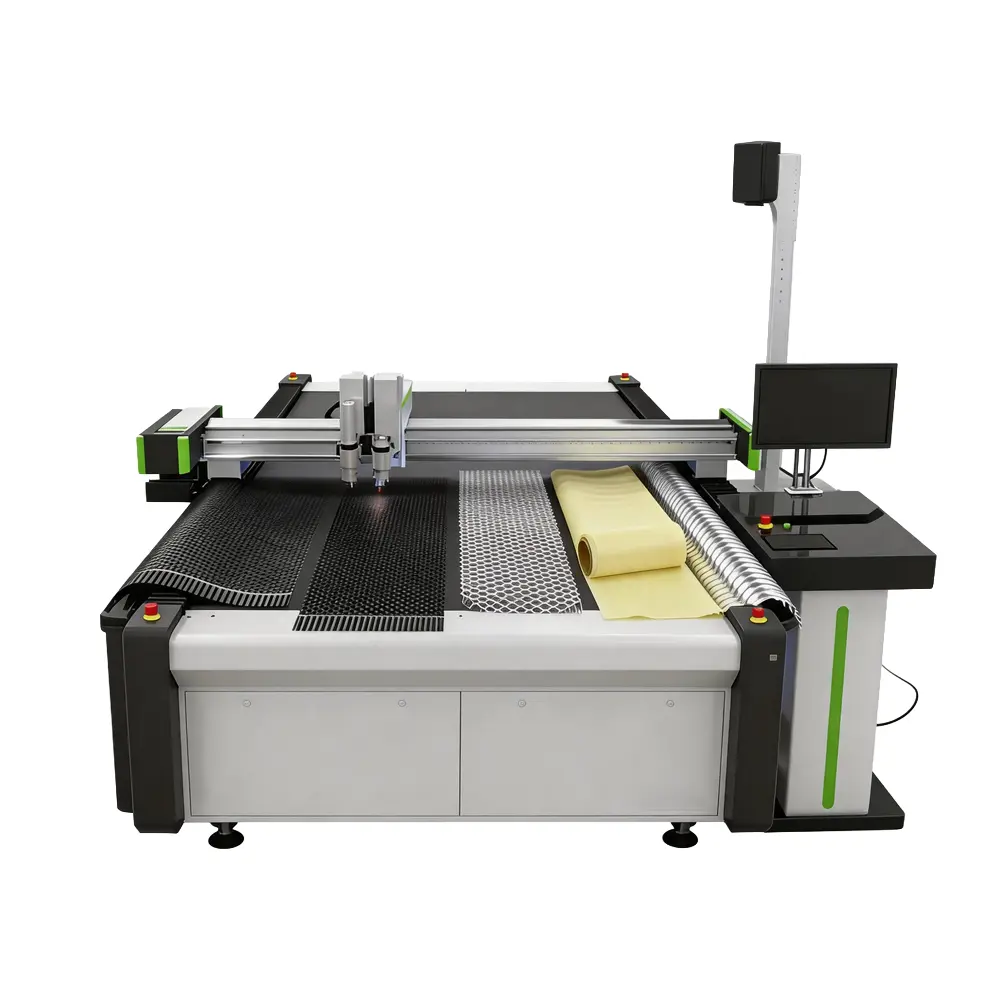
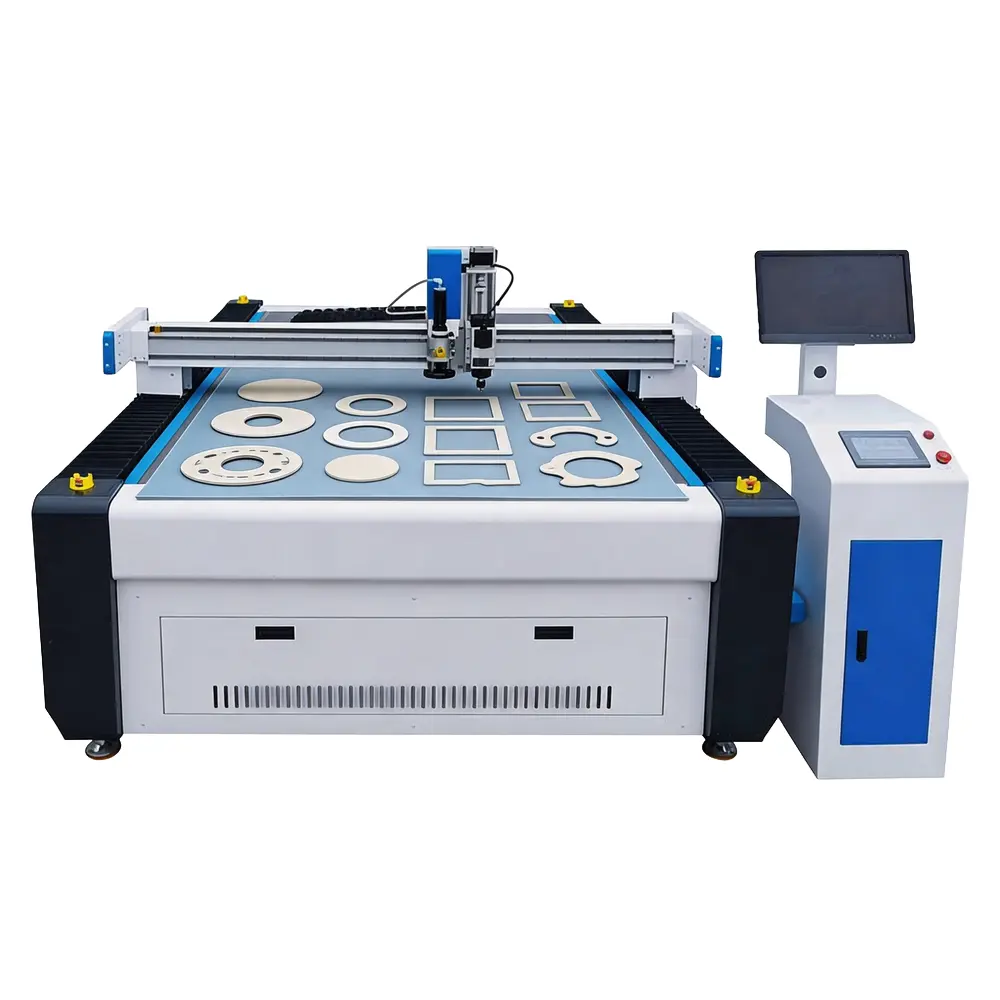
An oscillating knife cutting machine is a CNC digital cutting system that uses a rapidly moving blade to cut materials.
Instead of applying heat, the blade moves up and down at high frequency while the CNC system controls the X and Y movement according to a digital cutting file.
The result is a mechanical cold-cutting process.
A typical CNC oscillating knife cutting machine can combine several tools, depending on the application, including:
- Oscillating knife
- Pneumatic knife
- Drag knife
- Rotary knife
- Creasing wheel
- V-cutting tool
- Marking pen
- Punching tool
This makes a digital flatbed cutter more than a simple knife.
It is a flexible cutting platform that can be configured for different materials and production requirements.
For example, an oscillating knife can be used for leather, fabric, foam, rubber, gaskets, acoustic materials, cardboard and selected composite materials.
How Does Laser Cutting Work?
Laser cutting uses a concentrated beam of light to remove or separate material.
The laser generates heat in a very small area. Depending on the material, the cutting process can melt, vaporize or thermally decompose the material.
This technology is extremely useful for many applications, particularly rigid materials and materials that respond well to heat.
However, flexible materials can behave differently when exposed to high temperatures.
For some materials, the thermal effect is not a problem.
For others, it can affect the edge appearance, color, odor, dimensions or physical properties of the finished part.
This is where CNC knife cutting can become a better alternative.
Oscillating Knife vs Laser: The Key Difference
The biggest difference is simple:
Laser cutting is a thermal process. Oscillating knife cutting is a mechanical cold-cutting process.
| Factor | Oscillating Knife | Laser |
|---|---|---|
| Cutting method | Mechanical blade | Thermal beam |
| Heat affected zone | Minimal / none from the cutting process | Present |
| Burned edges | Generally avoided | Possible depending on material |
| Smoke / odor | No thermal smoke | Possible depending on material |
| Flexible materials | Excellent for many applications | Material dependent |
| Foam | Excellent for many foams | Some foams can melt or discolor |
| Leather | Clean cold cutting | May discolor or burn |
| Fabric | Suitable for many textiles | Material dependent |
| Rubber / gasket | Suitable for many sheet materials | Depends on rubber formulation |
| Digital cutting | Yes | Yes |
| Steel dies required | No | No |
| Multi-tool capability | Yes | Usually limited to laser-based processing |
| Creasing / marking | Possible with additional tools | Usually requires another process |
The table provides a general comparison. Actual cutting performance always depends on the specific material formulation, thickness and machine configuration.
1. Edge Quality: Why Cold Cutting Matters
One of the most important reasons manufacturers choose an oscillating knife is edge quality.
When a laser cuts a heat-sensitive material, the heat can cause:
- Melting
- Browning
- Yellowing
- Hardening
- Shrinkage
- Surface discoloration
- Unpleasant odors
The exact result depends on the material.
For example, a manufacturer cutting white foam may care much more about discoloration than a manufacturer cutting a hidden gasket.
Similarly, an automotive interior manufacturer may require the cut edge to retain the original appearance of the material.
Because an oscillating knife physically cuts the material instead of heating it, it avoids the thermal cutting zone associated with laser processing.
This is particularly useful when the finished edge is visible or when the material’s physical properties must remain unchanged.
2. Foam Cutting: Oscillating Knife vs Laser
Foam is one of the most interesting applications for comparing these technologies.
Different foams have very different structures and densities.
Common examples include:
- EVA foam
- EPE foam
- PU foam
- XPE foam
- EPP
- EPS
- Sponge
- Acoustic foam
A laser can interact strongly with some foam materials because of the heat generated during cutting.
Depending on the formulation and laser settings, the edge may melt, shrink, discolor or produce an unwanted odor.
An oscillating knife provides a mechanical alternative.
The blade moves rapidly through the foam while the CNC system follows the programmed geometry.
This makes oscillating knife cutting particularly attractive for applications where a clean mechanical edge is more important than thermal processing.
For manufacturers producing foam packaging, acoustic products, insulation components, automotive padding or custom foam parts, the ability to cut directly from CAD files can also eliminate the need to manufacture a new steel die for every design.
3. Leather Cutting: Why Many Manufacturers Prefer Knife Cutting
Leather is another material where the difference between thermal and mechanical cutting becomes important.
Natural leather can contain:
- Grain variation
- Surface defects
- Scars
- Stretching
- Thickness variation
- Irregular contours
When cutting leather, manufacturers often care about both edge quality and material utilization.
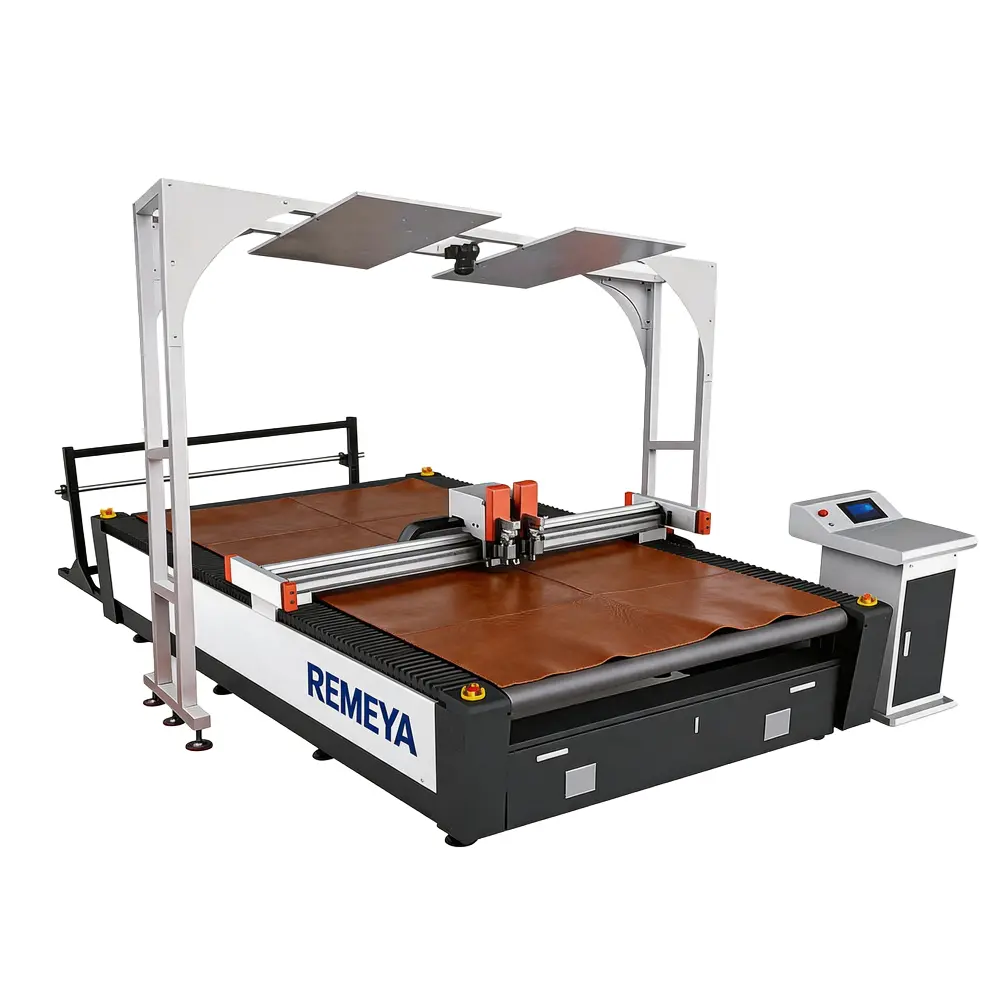
An oscillating knife cutting system can work with digital nesting software and, when configured with vision technology, can help position patterns according to the actual shape and defects of the hide.
This is especially useful for:
- Automotive seats
- Shoes
- Handbags
- Luggage
- Furniture upholstery
- Leather accessories
Laser cutting can be suitable for certain leather applications, but the thermal effect must be considered carefully.
If discoloration, burning or odor is unacceptable, cold knife cutting can offer a significant advantage.
4. Fabric Cutting: The Challenge Is Material Movement
Textiles introduce another challenge.
Unlike rigid sheets, fabric can:
- Stretch
- Move
- Fray
- Compress
- Curl
- Change shape under tension
For this reason, the cutting process needs to control the material as well as the tool.
A CNC fabric cutting machine can use vacuum adsorption, suitable knife geometry and optimized cutting parameters to maintain the material during cutting.
Oscillating knives can be used for many types of textile materials, including:
- Woven fabrics
- Knitted fabrics
- Non-woven materials
- Felt
- Upholstery fabrics
- Technical textiles
- Foam-backed fabrics
For multilayer production, the machine configuration becomes even more important.
Material spreading, vacuum holding, knife selection and cutting parameters all affect the final result.
This is why manufacturers should evaluate the complete cutting system rather than choosing a machine based only on maximum cutting speed.
5. Rubber and Gasket Cutting
Gasket manufacturers often face a different problem.
Many gasket materials are available in sheets, and product designs can change frequently.
Traditional die cutting requires a steel rule die for each shape.
This can be efficient for very large production runs with stable designs, but it becomes less attractive when a manufacturer produces:
- Prototypes
- Small batches
- Custom gaskets
- Many different sizes
- Frequently changing designs
A CNC oscillating knife cutting machine can follow digital CAD files directly.
This means a new design can be produced without manufacturing a new physical die.
For gasket and sealing applications, appropriate blade selection, cutting depth, material fixing and machine configuration are important.
The machine should therefore be selected according to the actual rubber or gasket material rather than simply by maximum advertised thickness.
6. No Die Cost for Digital Cutting
One major advantage of CNC knife cutting is the digital workflow.
The basic process is:
CAD file → Nesting → Tool selection → Vacuum fixing → CNC cutting
Instead of creating a physical die for every new shape, the machine follows the digital geometry.
This is especially valuable for companies producing:
- Custom products
- Prototypes
- Samples
- Small batches
- Many product variations
- Short production runs
If the design changes, the digital file can simply be modified.
There is no need to manufacture a completely new steel die.
This flexibility is one of the reasons digital cutting machines have become increasingly useful in modern manufacturing.
7. Which Machine Is More Suitable for Flexible Materials?
There is no universal answer.
The correct choice depends on your material and production requirements.
Choose an oscillating knife when:
- You need cold cutting
- Burn marks are unacceptable
- Material discoloration is a concern
- You cut foam or other heat-sensitive materials
- You work with leather or textiles
- You produce gaskets or rubber sheets
- You frequently change product designs
- You need multiple cutting tools
- You want die-less digital production
- You need to cut complex shapes from flexible materials
Consider laser cutting when:
- The material is suitable for thermal processing
- The thermal effect does not damage the product
- Very fine laser features are required
- The application specifically benefits from laser processing
- The material and production process have already been validated with laser cutting
The important point is not to choose a technology based only on machine specifications.
The material test should come first.
8. How to Choose the Right Oscillating Knife Cutting Machine
If you are considering a CNC oscillating knife cutter, evaluate these factors before purchasing.
Material
What exactly are you cutting?
Leather, EVA foam, rubber, fabric and composite materials require different cutting strategies.
Thickness
Measure your normal production thickness, not only the maximum thickness you occasionally encounter.
Cutting Area
Choose a working area that matches your standard sheet, hide or material roll.
Common industrial formats include approximately 1600 × 2500 mm and larger customized working areas.
Tool Configuration
Do you only need an oscillating knife?
Or do you also need:
- Drag knife
- Pneumatic knife
- Rotary knife
- Creasing wheel
- V-cutting
- Punching
- Marking
A multi-tool configuration can make one CNC platform useful for several production processes.
Material Fixing
Flexible materials can move during cutting.
A vacuum adsorption table or conveyor-based vacuum system can help stabilize the material during processing.
Nesting Software
For expensive materials such as leather, material utilization can have a major impact on production cost.
Good nesting software can arrange parts efficiently and reduce unnecessary waste.
After-Sales Support
A cutting machine is not just a mechanical system.
Software, blades, cutting parameters, vacuum systems and machine calibration all influence production.
For this reason, technical support and material testing should be part of the purchasing decision.
9. Why Material Testing Should Come Before Machine Selection
One of the biggest mistakes when purchasing a digital cutting machine is asking:
“What is the maximum thickness this machine can cut?”
A better question is:
“How does this machine cut my actual material?”
Two materials with the same thickness can behave completely differently.
For example:
A 20 mm soft foam and a 20 mm dense rubber sheet are not equivalent cutting applications.
The appropriate blade, cutting speed, oscillation parameters and vacuum settings may be different.
Before purchasing an industrial CNC cutting machine, manufacturers should ideally test:
- The actual material
- The actual thickness
- The actual product geometry
- The required edge quality
- The required production speed
- The expected daily output
This provides much more useful information than comparing brochure specifications alone.
10. Final Verdict: Oscillating Knife or Laser?
For flexible and semi-rigid materials, an oscillating knife cutting machine can provide several important advantages because it uses mechanical cold cutting instead of heat.
It is particularly attractive for manufacturers working with:
Leather + Foam + Fabric + Rubber + Gaskets + Felt + Acoustic Materials + Selected Composite Materials
The biggest advantages are:
- No thermal cutting zone
- Clean mechanical cutting
- No steel die required
- Flexible digital production
- Multiple tool options
- Suitable for many flexible materials
- Easy design changes
- CNC-controlled repeatability
However, laser cutting remains an effective technology for applications where thermal processing is acceptable or where laser-specific capabilities are required.
The best solution depends on the material and the production process.
For this reason, manufacturers should test their actual materials before selecting a machine.
Looking for an Oscillating Knife Cutting Machine?
REMEYA manufactures CNC oscillating knife cutting machines for flexible and semi-rigid materials.
Our digital cutting systems can be configured for different applications, including:
- Leather cutting
- Fabric cutting
- Foam cutting
- Gasket cutting
- Acoustic material cutting
- Composite material cutting
- Cardboard and packaging cutting
Depending on the application, machines can be equipped with oscillating knives, pneumatic knives, drag knives, creasing tools, marking tools and other cutting options.
If you are comparing laser cutting with CNC knife cutting, send us your material type, thickness, sheet size and sample drawing.
We can recommend a suitable cutting configuration and arrange a material cutting test before you make a purchasing decision.
Contact REMEYA for a free cutting test and machine recommendation.