Introduction: One Misunderstanding Cost Much More Than Expected
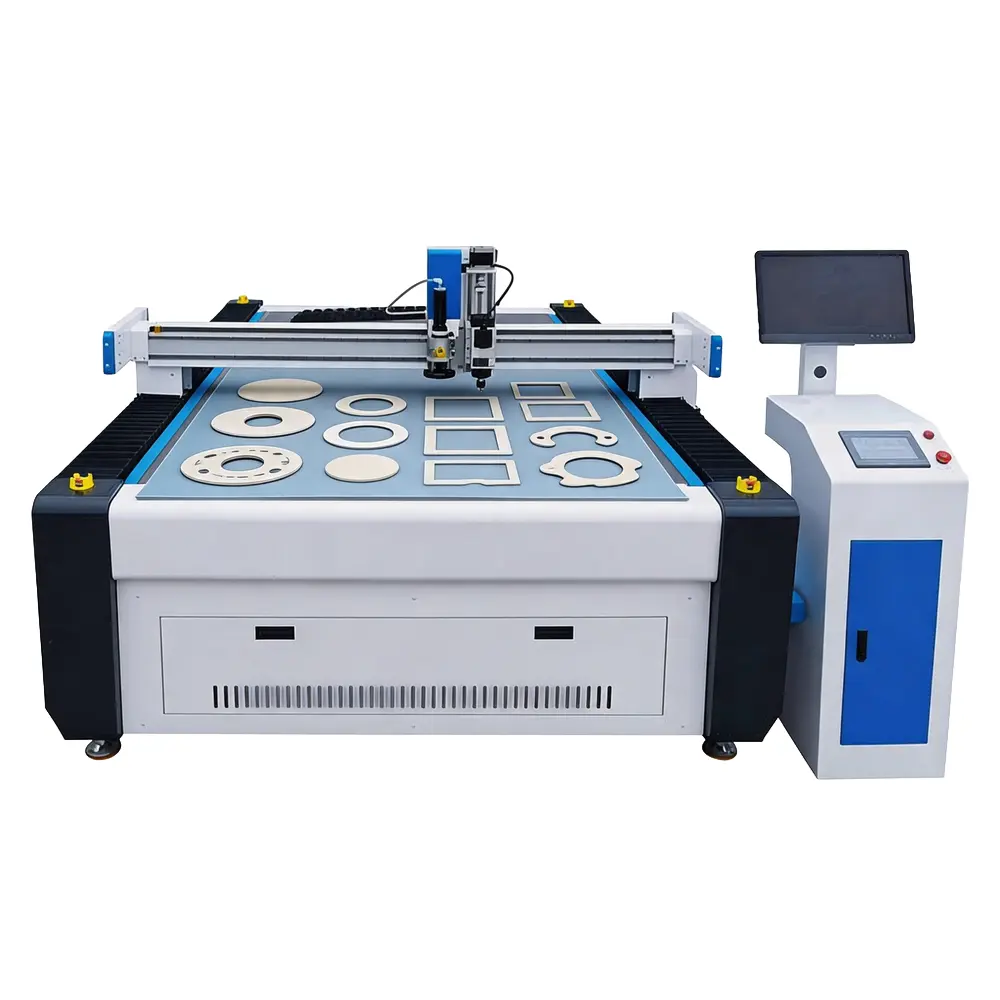
While a CNC cardboard cutting machine performs basic operations, I use it for cutting, creasing, slitting, V-cutting, and printing. It means that packaging producers will be able to create samples, manage short-run production, and deliver customized boxes with higher efficiency.
However, before I discuss different types of CNC cardboard cutting machines, there is an important misunderstanding that must be cleared out. Most buyers of these machines ask one question only: “Does it perform cutting?” In my experience, that is not enough. A cardboard box includes a lot of different operations. It should be folded correctly, have a nice appearance, be assembled easily, aligned perfectly, and have other necessary qualities. Hence, while evaluating the performance level of a CNC cardboard cutting machine, which is typically recommended, I consider its ability to carry out the whole sequence of operations. Read this article until the end to find out why.
Why a CNC Cardboard Machine Is Not Just a Cutter
In most cases, people think too little about the product, rather than about technology. At the beginning of any discussion about CNC machines, I always say the following: cardboard box manufacturing is a complex process, so a CNC machine should be able to execute a variety of functions, such as cutting, creasing, slitting, and marking.
What Does Real Processing Capability Mean?
Typically, I pay attention to several factors when discussing CNC machines with packaging clients. These include machine speed, which is essential. However, speed alone cannot turn cardboard into a perfect box. In the packaging industry, each sheet usually requires an outer cutting line, fold lines, spaces for cutting waste, slots, hand holes, and positioning markings. Some special structures, including display boxes, often require bevel cuts so that cardboard can be bent perfectly. Therefore, I prefer using the term “cutting machine” rather loosely.
Why One Platform Reduces Waste
If a CNC machine is able to cut, crease, slit, V-cut, and print on the same platform, it is possible to minimize the handling time and number of possible errors. When using manual labor, each operator can move the board between stations, so fold lines, slits, and other markings might become misaligned. In case a machine is used, all operations should be carried out sequentially. I put a piece of cardboard to the machine, and it performs everything I need.
Why It Matters for Small Batch Orders
The advantage of multifunctional CNC machines is especially noticeable for packaging manufacturers that produce boxes on demand. Die cutting is still the right method to use in cases of very big orders, but for samples, proofing, testing, season packages, and smaller volumes, CNC machines are more appropriate since they allow changing file data and producing a batch quickly and without waiting.
What Operations Should Be Performed by the Machine?
A box production process without creasing is impossible to complete. I evaluate a CNC machine according to its capabilities of carrying out cutting for the shape of the box, creasing for folding, slitting for creating a structure, V-cutting for special angles of cutting, and marking for better assembly and production process organization.
| Operation | Description | Value for packaging manufacturing | Standard tool |
|---|---|---|---|
| Cutting | Cuts the outer shape of the cardboard box | Defining the box size and contours | Knives or oscillators |
| Creasing | Creases the fold lines without cutting through | Helps in folding the box precisely | Creasing wheel |
| Slitting | Creases a gap in cardboard | Enables inserting pieces and locking them together | Knife or slit-specific tool |
| V-cutting | Cuts away a piece of cardboard at an angle | Better angles for display structures, flaps, etc. | V-cutting tool |
| Marking | Leaves markings, codes, and notes in place | Helps assembly operators and production staff | Pen or marking tool |
Cutting Is Only the Starting Point
An outer cutting operation is the main feature of CNC cardboard cutting machines and is noticed instantly. However, even such a simple operation should be performed precisely. Corrugated cardboard is made of different parts and layers, so it is important to choose a proper tool and stable pressure to prevent the edges from cracking, crushing, and leaning. Edge quality, sharp corners, and precision on curves should be taken into consideration.
Creasing Decides If the Box Can Be Folded Correctly
Although this operation is less visible, creasing line quality is crucial. Most clients request cutting samples but overlook the quality of folds. If a creasing line is either too soft or too strong, folding might become difficult. A too strong line damages the surface of the box, so the latter appears unattractive, whereas a too soft line means resistance to folding. This is why creasing is also considered an essential operation in my view.
Slotting, V-Cutting, and Marking Are Important for Efficient Manufacturing
These operations are important for specific reasons. In the case of corrugated cardboard, slits determine how the box will be assembled. It means that in order to achieve efficient production, the slits should be neither too tight nor too broad. V-cutting is needed for display purposes, thick cardboard folding, and various design tasks where proper angles are essential for the final look of a box. Finally, markings are needed for efficient production management.
How Does CNC Cutting Compare with Manual Cutting and Die Cutting?
These approaches might seem inexpensive, but they have flaws. While deciding whether to use a CNC machine, I also evaluate the potential of manual cutting and die cutting based on the client’s order type, batch volume, the possibility of design changes, and deadlines.
Manual Cutting – Versatile but Inefficient
It is evident that manual cutting can be used for the most complex tasks. It is easy, flexible, and effective when it comes to the smallest volumes. However, this method lacks stability. Operator’s skills are required to produce high-quality results, but they vary from worker to worker. It might take some time to learn the proper technique. Folding lines are difficult to replicate. At first glance, it is easy, but the efficiency of production falls when volumes increase.
Die Cutting – Strong for Big Stable Orders
Die cutting works well for large repeat orders. Once the die is ready, output is high. But dies cost money, and design changes add time and expense. That’s why die cutting isn’t ideal for samples, custom sizes, or frequent SKU changes. For factories serving many custom clients, digital processing fits better for short runs and front-end work.
CNC – Balance of Flexibility & Capability
A CNC cardboard cutting machine lets me load a file, tweak the design, and run a new sample without waiting for tooling. I can also combine multiple functions on one table. For custom packaging businesses, this balance often beats pure speed. It helps R&D test faster, sales confirm structures, and production handle mixed small orders – protecting profit in real factories.
Which Tools & Features Matter Most?
A powerful machine with wrong tools still fails. I don’t just ask about bed size or motor brand. I ask which tools are included, table stability, and how well the machine holds the board flat.
Tool Combination Defines Job Range
For corrugated work, I need several tools: an oscillating knife for contours, a creasing wheel for fold lines, a marker for text/guides, and a V-cut tool for angled structures. That combo delivers real value. A machine with only a cutting tool is too narrow – don’t overlook this.
Table & Vacuum – More Important Than You Think
Cardboard seems light, but if the sheet shifts, even a sharp tool fails. A flat table and stable vacuum keep the board in place. That’s critical for long cuts, repeat parts, and crease accuracy. Poor holding causes small movements → wrong fold positions → bad boxes.
Software & Path Control Matter Daily
Software isn’t decoration – it drives efficiency. I need easy file import, simple layer control, and clear tool assignment. Operators should define cut, crease, slot, and marking layers without confusion. Good software cuts training time and setup errors. Many delays come from bad workflow, not bad motors.
What Products & Materials Can It Handle?
If the board changes, the process must change. Ask not just “Can it cut cardboard?” but “Which cardboard, which box type, which production target?”
Corrugated Board Isn’t Uniform
Different flutes, thicknesses, and surfaces exist – from shipping board to retail packaging to laminated sheets. Match tool path and pressure to the actual board. Test with your real material, not just a nice demo.
Common Packaging Jobs
These machines handle shipping cartons, custom mailers, folding cartons, samples, inserts, protective packaging, and displays. Simple RSC boxes need cut+crease. Retail displays need more slotting, marking, and V-cutting. Value comes from process breadth – the more styles you produce, the more that breadth matters.
Simple Capability Map
- Simple carton → Cut + Crease
- Mailer box → Cut + Crease + Slot
- Display stand → Cut + Crease + Slot + V-Cut
- Sample making → Fast file change + Multi-process
- Custom short run → Flexible setup + No die
This is a value chart, not a speed chart. It shows where CNC becomes more useful as complexity and variation increase.
How to Choose the Right CNC Cardboard Cutting Machine?
A wrong machine saves money only on the quote sheet. Choose based on process, order type, and future product mix – not the cheapest price.
Start with Your Real Jobs, Not the Catalog
Ask three questions: What materials do I process most? What box structures do I make most? What’s my batch pattern (samples, short runs, mass production)? A sample-focused factory needs fast file changes and full flexibility. A high-volume factory may use digital cutting for proofing but keep die cutting for mass output.
Check the Process List Before the Price
Many buyers compare quotes line by line but ignore process ability. Check supported operations, included tools, working size, vacuum strength, software ease, and sample results on your own board. A lower price that removes marking, V-cutting, or strong creasing isn’t fair – it may create more manual work later.
Ask for Proof from Your Own Material
Always test with your actual corrugated board. The supplier should show cut edges, fold lines, slot fit, angle work, and repeat accuracy. Real samples tell the truth faster than any spec sheet.
Final Thought
A CNC cardboard cutting machine should solve the whole box process – not just the cut line. Choose wisely, test with your materials, and focus on the full range of operations. That’s how you protect time, material, and profit.