1. What Are the Benefits of Proper Tool Selection?
Gaskets are designed for many purposes: protecting parts from corrosion, being resistant to hot liquids, etc. But the most important advantage for engineers is the possibility of easy cutting of the material.
Each material requires a unique way of processing:
- Rubber is easily stretched when pressure is applied;
- Non-asbestos is dense and cracks easily;
- PTFE is slippery and difficult to hold;
- Graphite is soft and tends to damage the blade.
Incorrect choice of tools will lead to inaccurate parts, stretching and breaking of edges. Plus, such work will take a lot of time and material.
2. How to Cut Rubber Gaskets?
Rubber is often used in industry. There are many advantages of it: temperature stability, ability to withstand pressure, etc. The main problem associated with this material is its elasticity.
How to overcome this disadvantage?
First of all, if the thickness of the sheet is above 4 mm, you must use a pneumatic oscillating knife with high amplitude.
However, if the sheet is thinner, it should be cut using an electric oscillating knife.
Vacuum table is needed to hold the sheet in place.
Use cases are: oil seals, water pumps, and other engine components.
3. How to Process Non-Asbestos Gaskets?
This type of material is often used in industry nowadays, as it is resistant to high temperatures and abrasions. You can often find it in pipelines, oil wells, etc.
Main issues related to non-asbestos material:
- Laser might burn the sheet;
- Waterjet cutting requires large costs for equipment and consumables;
- Material is hard and brittle.
What to do about it?
Use an electric oscillating knife with a power of 400 watts. Such equipment will provide the necessary power. Besides, no burning will take place, and the parts won’t have marks of burning or dark residue.
Use cases: pump seals, pipeline seals.
4. How to Cut PTFE Gaskets?
This material is also often used in industrial practice. Main advantages are:
- Resistance to any chemical substances;
- Ability to withstand mechanical stresses;
- It doesn’t react with adhesives and easy to clean.
Challenges associated with PTFE:
- Material is too slippery for traditional blades;
- PTFE sheet might slip.
What can be done about it?
To cut it properly, an oscillating knife with 400 watts of power and reinforced blades is needed.
Also, vacuum table helps to fasten the sheet.
Area of application: chemical industry, processing facilities, pharmaceuticals.
5. How to Process Graphite-Reinforced Gaskets?
This kind of material consists of graphite mixed with stainless steel and metal mesh. Thus, they are capable of resisting high temperatures and pressures.
Problems that arise when processing such material:
- Low durability of blades due to metal layers;
- Soft inside material.
Solutions:
Use pneumatic oscillating knife and reinforced blade for this purpose.
Although you will need to replace the blades more frequently, they will last longer than regular ones.
Areas where this gasket is used: oil and gas wells, power plants, steam systems.
6. One Machine for Many Types of Materials
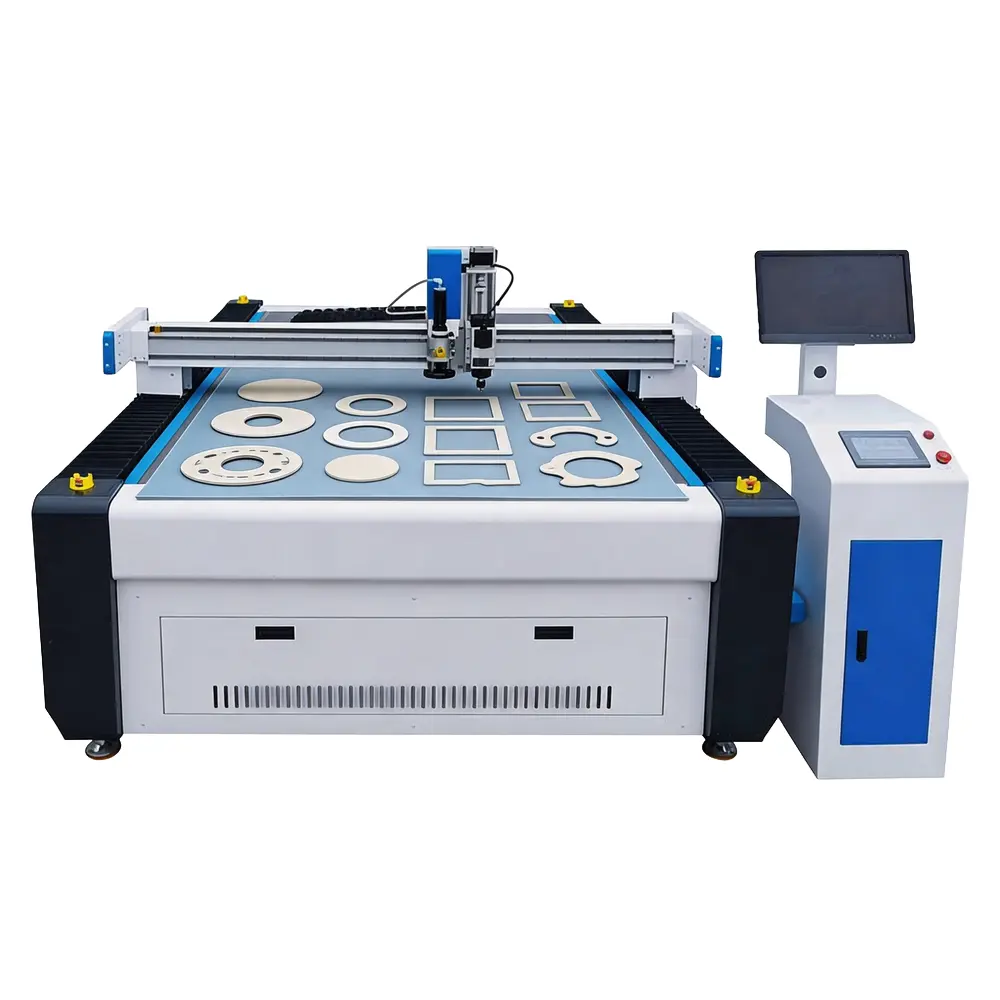
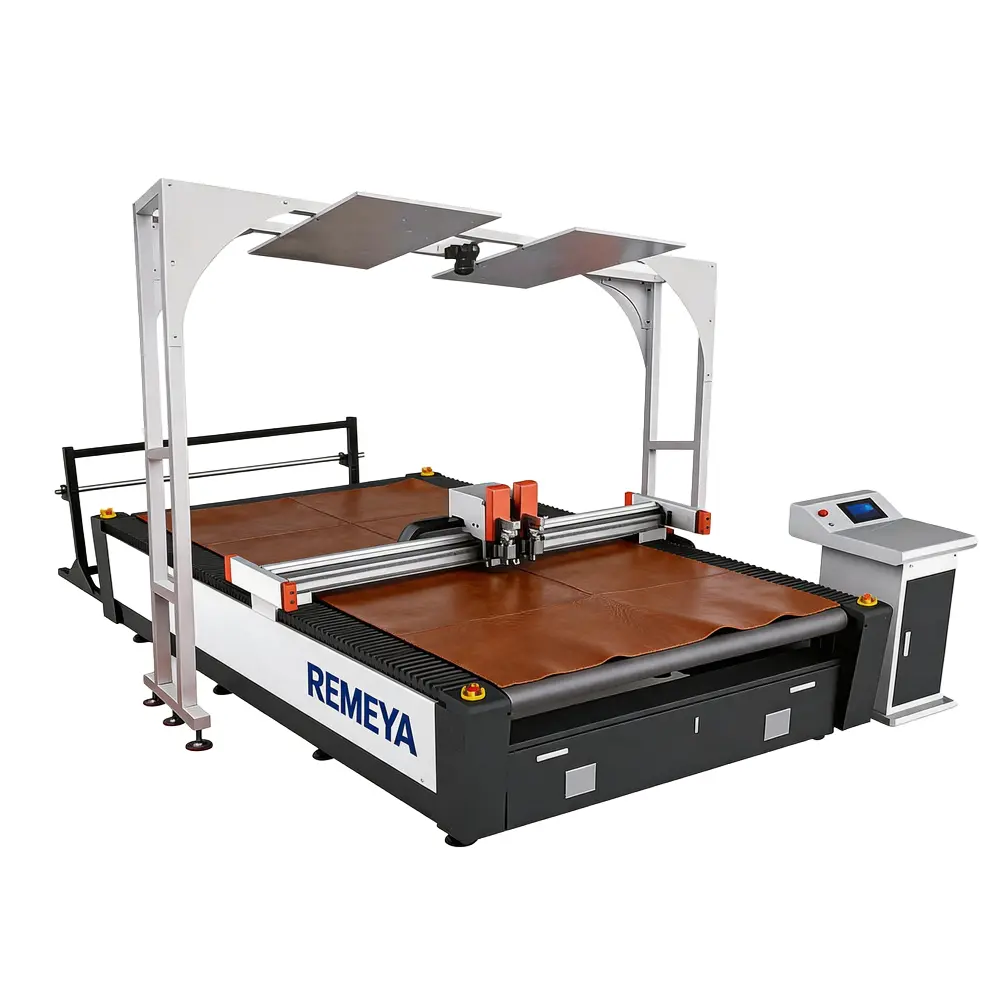
There is no need to invest money into purchasing equipment for cutting each material separately. You can easily change tools to work with different materials. All you need is CNC oscillating knife cutting machine.
Steps of proper tool selection:
- For rubber and graphite-reinforced sheets: pneumatic oscillating knife
- For non-asbestos and PTFE sheets: 400 watts electric oscillating knife
- For thin rubber: high-frequency oscillating knife
- Milling cutter (optional): ultra-hard materials
Table of recommended tools:
| Material | Tool | Power (W) | Thickness range (mm) | Problem |
|---|---|---|---|---|
| Rubber | Pneumatic / high-frequency | – | 1–20 | Elasticity of the material |
| Non-asbestos | Electric (400 W) | 400 | 1–10 | Density and brittleness of the material |
| PTFE (Teflon) | Electric (400 W) | 400 | 1–6 | Needs to be securely fastened |
| Graphite Reinforced | Pneumatic + reinforced blade | – | 1–5 | Blades wear out quickly |
7. Real Life Example: Gasket Cutting Company in India
There is a company from India among our clients. They manufacture gaskets with the help of dies. For each unique part, this method required weeks and a lot of resources.
However, after acquiring CNC oscillating knife cutting machine with two tool heads (pneumatic and 400 watts electric), the client managed to cut several kinds of gaskets:
- 3 mm rubber gaskets (for automotive)
- 2 mm non-asbestos gaskets for pumps
- 4 mm PTFE gaskets (for chemical industry)
- Graphite-reinforced gaskets with metal
No additional costs were incurred: just import a CAD-file and get accurate parts.
As a result, the company received:
- 50% reduction of time for custom part production;
- 30% reduction of costs due to nesting software;
- Machine repaid itself in 12 months.
8. Frequently Asked Questions Concerning Gasket Cutting Machine
Q1: What kind of materials can be used in this machine?
This CNC cutting machine allows you to work with almost any material. It could be rubber, non-asbestos, PTFE, graphite, and others. Changing tools makes it possible to cut various kinds of materials.
Q2: Why not use laser or waterjet technologies for cutting?
Some lasers can burn and leave a trace of burning in some cases. Besides, waterjet technology requires lots of resources and energy. Oscillating knives perform cold cuts without any mess.
Q3: What kind of tools should I use for specific materials?
For rubber – pneumatic or high-frequency oscillating knife;
For non-asbestos – electric oscillating knife with power of 400 watt;
For PTFE – electric oscillating knife with 400 watts of power and vacuum table;
For graphite – pneumatic oscillating knife with reinforced blade.
Q4: Can one machine process all materials?
Yes, you can use multiple tools to work with various materials without any additional expenses.
Q5: What are the benefits of CNC gasket cutting machine?
No need to purchase dies and molds;
Short transition times between parts;
Accuracy;
Great performance in small series;
Safety.
Conclusion
From stretchy rubber to stubborn PTFE, from brittle non-asbestos to metal-reinforced graphite—each material has its own personality. But with the right tool configuration, one CNC gasket cutting machine can handle them all.
No molds. No fumes. No headaches.
Just smooth, precise, and efficient gasket production.
So the next time you’re staring down a tricky sheet of PTFE or graphite-reinforced material, remember: it’s not about fighting the material. It’s about letting the right machine—and the right blade—do the heavy lifting for you.