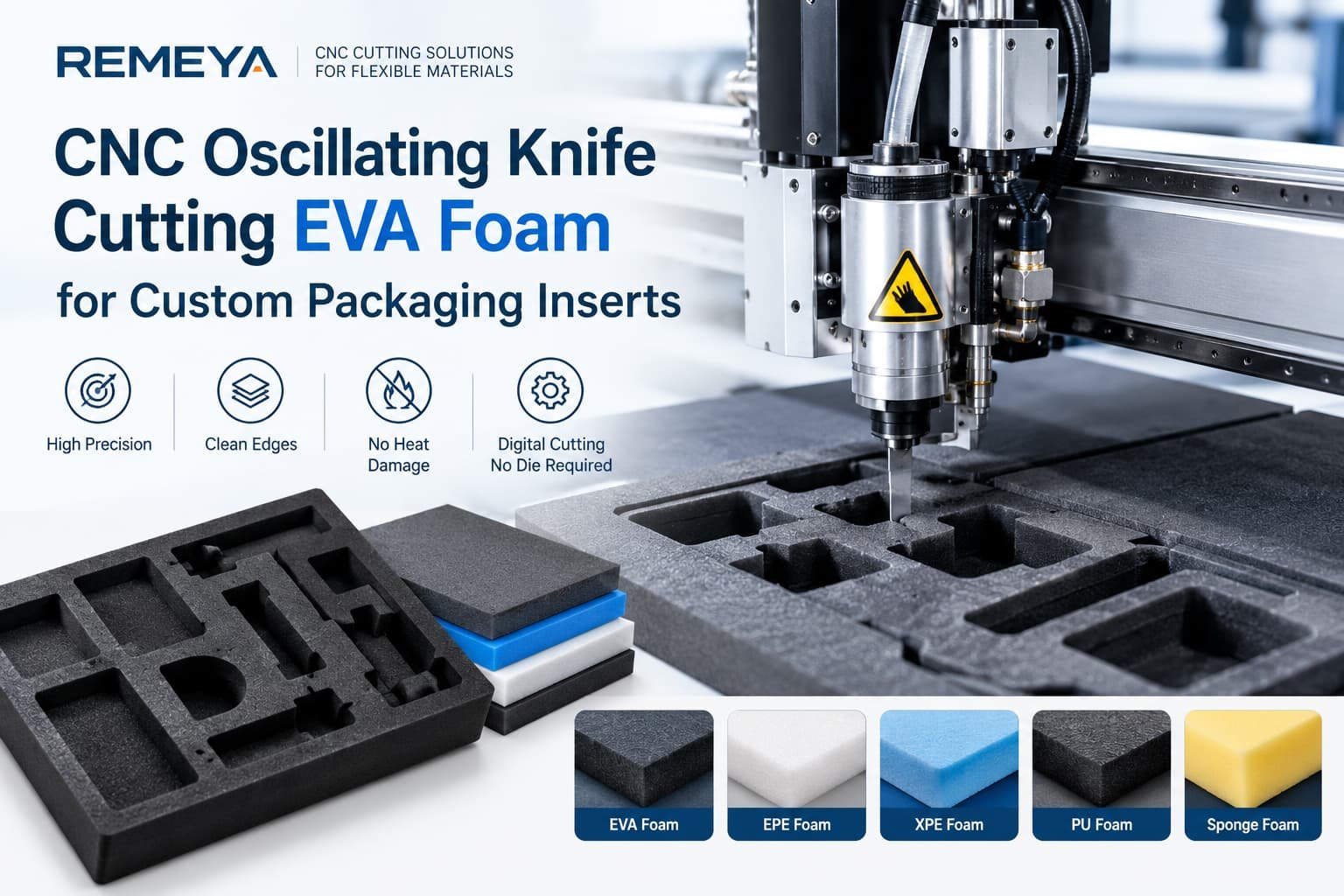
EVA foam is widely used for packaging inserts, footwear components, protective padding, automotive parts and custom industrial products. However, cutting EVA foam accurately is not as simple as cutting a rigid sheet.
The material can compress, stretch, deform or produce uneven edges when the wrong cutting method is used. For manufacturers producing different shapes, small batches or custom foam parts, choosing the right cutting process is an important production decision.
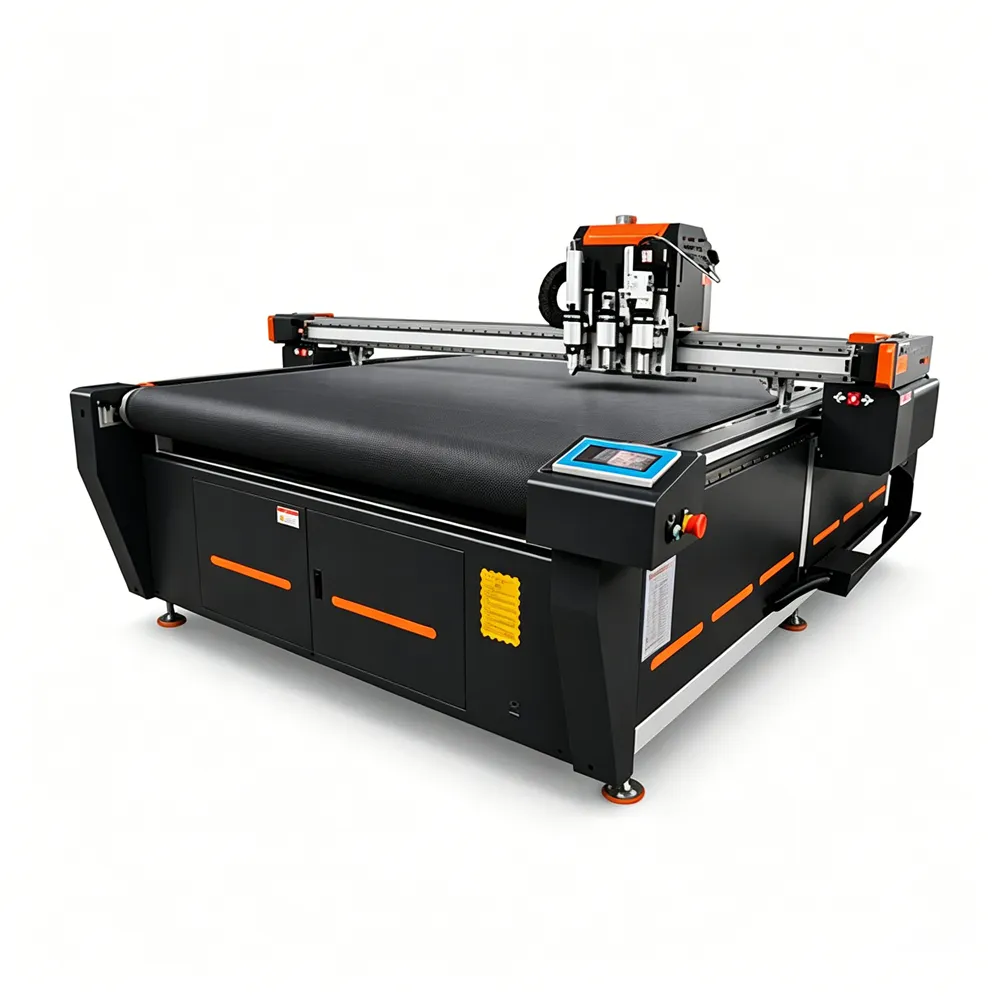
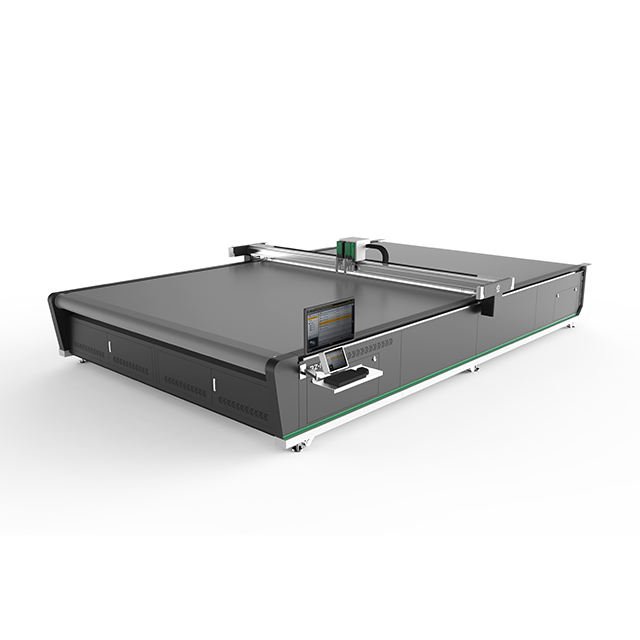
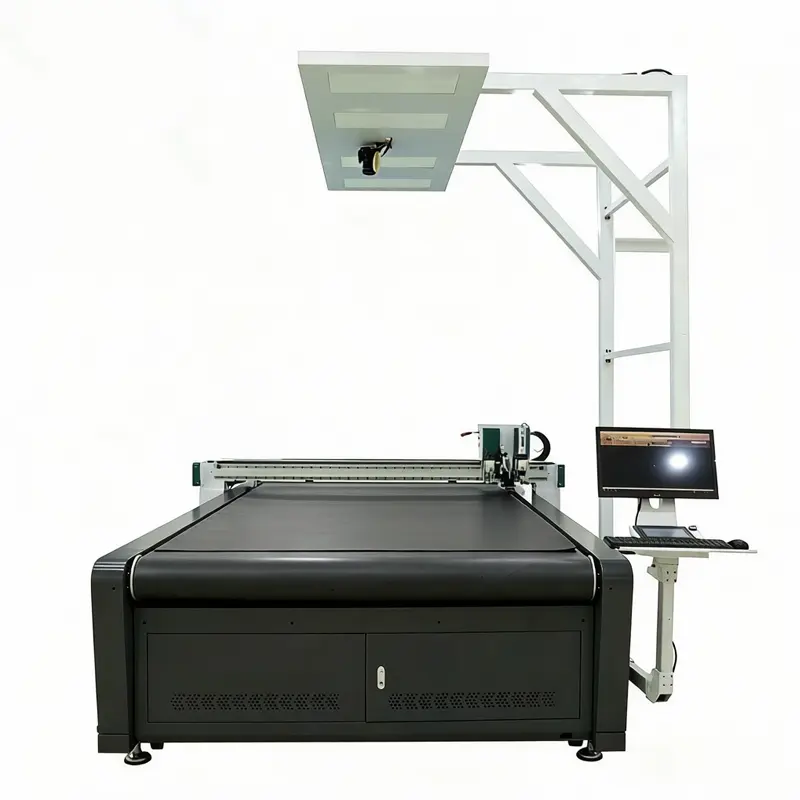
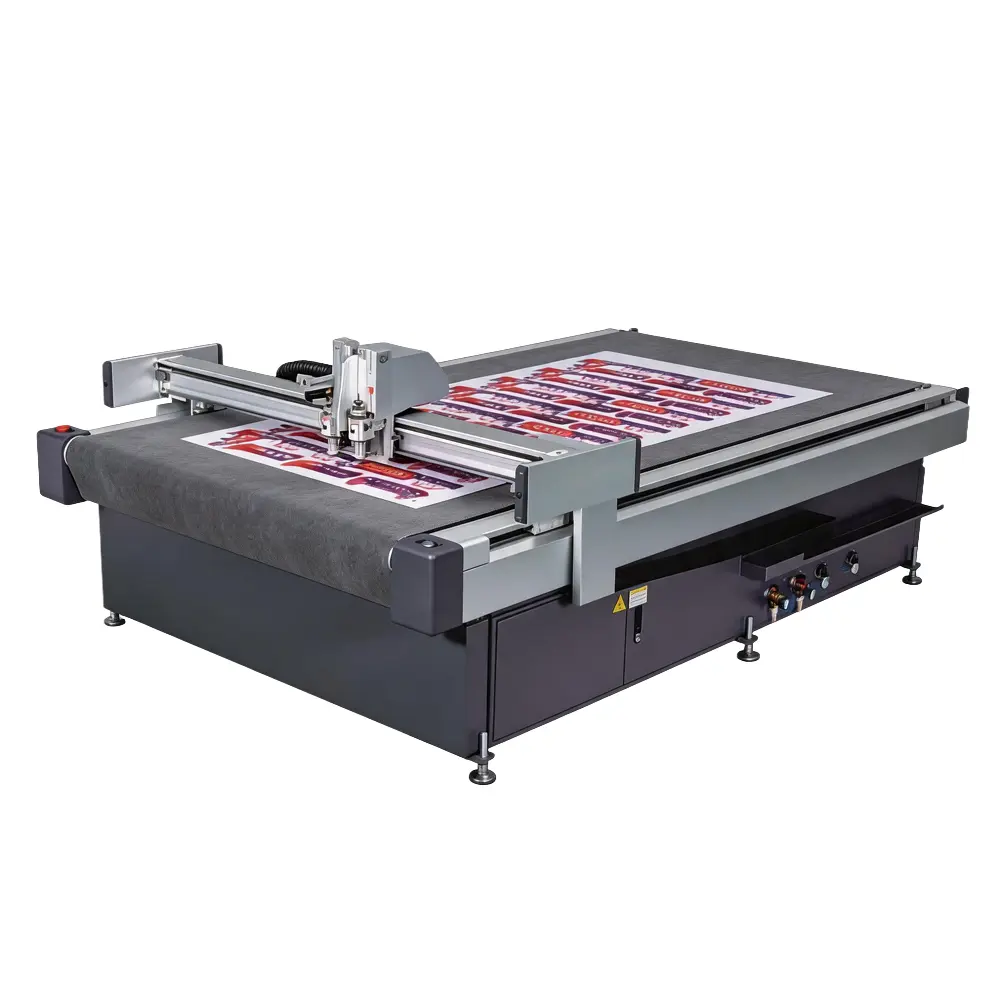
A CNC oscillating knife cutting machine provides a digital cutting solution for many EVA foam sheet applications. Instead of using heat, the machine uses a vibrating blade to follow a programmed cutting path.
This article explains how to cut EVA foam, what affects cutting quality, and how to choose a suitable CNC foam cutting machine.
What Is EVA Foam?
EVA stands for ethylene-vinyl acetate. It is a lightweight, flexible foam material used in many manufacturing applications.
Common EVA foam applications include:
- Protective packaging inserts
- Tool and equipment cases
- Footwear components
- Sports padding
- Automotive interior parts
- Industrial gaskets and pads
- Custom foam prototypes
- Acoustic and insulation products
EVA foam is available in different densities, thicknesses, surface finishes and formulations. These differences can significantly affect how the material behaves during cutting.
For this reason, a cutting method that works well for one EVA foam may not produce the same result on another.
Why Is EVA Foam Difficult to Cut?
EVA foam is compressible. When a cutting tool applies force, the material may move or deform before the blade passes through it.
This can create several problems:
- Uneven dimensions
- Slanted or irregular edges
- Incomplete cuts
- Surface deformation
- Material waste
- Inconsistent internal pockets
- Difficulty maintaining repeatability
The problem becomes more noticeable when manufacturers need to cut complex shapes, internal holes, slots or custom packaging cavities.
A successful EVA foam cutting process therefore depends on more than machine speed. It also depends on the material, blade, cutting depth, toolpath and material holding method.
How Does a CNC Oscillating Knife Cut EVA Foam?
A CNC oscillating knife cutting machine uses a rapidly moving blade to cut through the foam while the machine follows a digital design.
The basic workflow is:
CAD file → Material preparation → Tool selection → Cutting parameters → CNC cutting → Quality inspection
The oscillating movement helps the blade penetrate the material while the CNC system controls the cutting path.
Unlike laser cutting, the process does not rely on a heat beam to separate the material. This makes cold knife cutting attractive for applications where the manufacturer wants to avoid thermal effects.
For EVA foam, the final result still depends on the specific material and machine configuration. A cutting test is the best way to confirm whether the process meets the required edge quality and dimensional accuracy.
Step 1: Identify the EVA Foam Material
Before selecting a machine, record the actual material specifications.
Important information includes:
- EVA foam type
- Density
- Thickness
- Sheet size
- Surface coating
- Lamination
- Required edge quality
- Production quantity
For example, a thin EVA foam sheet used for packaging may require a different cutting setup from a dense foam component used in footwear.
If the material has a laminated surface, adhesive backing or multiple layers, the cutting tool may also need to be selected differently.
Step 2: Prepare the CAD File
A CNC cutting machine follows digital geometry.
The design should be prepared as a clean vector file, such as DXF, AI, PLT, SVG or another format supported by the machine software.
Before cutting, check that:
- The contours are closed
- Duplicate lines are removed
- Internal holes are correctly defined
- Cutting paths are not overlapping
- Different operations are separated when necessary
- The design matches the actual material dimensions
For custom packaging inserts, the CAD file may contain an outer profile, internal cavities, slots and other features.
A clean file helps reduce cutting errors and makes production changes easier.
Step 3: Choose the Right Cutting Tool
EVA foam can require different cutting tools depending on its thickness, density and geometry.
A CNC foam cutting machine may be configured with tools such as:
- Oscillating knife
- Drag knife
- Tangential knife
- Rotary knife
- Creasing tool
- Milling tool
The oscillating knife is commonly used for cutting foam profiles and other flexible materials.
However, the correct blade length, blade geometry and tool configuration should be selected according to the actual material.
A thicker or denser foam may require a different cutting approach from a thin, soft sheet.
The best tool is not necessarily the fastest tool. It is the tool that produces the required result consistently.
Step 4: Set the Cutting Parameters
Cutting parameters should be tested on the actual EVA foam.
Important parameters may include:
- Cutting speed
- Oscillation frequency
- Blade depth
- Down pressure
- Number of passes
- Toolpath direction
- Material fixing method
There is no single cutting parameter that works for every EVA foam.
A parameter that is suitable for one density or thickness may produce compression, tearing or incomplete cuts on another.
For this reason, manufacturers should use test cuts to establish a suitable material profile before starting production.
Step 5: Fix the Material Properly
Material movement is one of the most common causes of cutting problems.
A CNC foam cutting machine may use a vacuum adsorption table to help hold the foam in place during cutting.
This is especially useful when cutting:
- Large foam sheets
- Thin foam
- Flexible materials
- Complex contours
- Internal cavities
- Repeated production parts
The material should be placed flat and held consistently.
If the foam is compressed, rolled or uneven before cutting, the final dimensions may be affected.
Step 6: Optimize the Cutting Sequence
The cutting sequence can influence the final result.
For example, internal holes or pockets may need to be cut before the outer profile.
If the outer shape is cut first, the remaining material may become less stable during subsequent operations.
For custom foam inserts, a well-organized cutting sequence can help maintain the position of the part during production.
The exact sequence depends on the machine software, material and design.
Step 7: Inspect the Finished Foam Parts
After cutting, inspect the finished parts carefully.
Check:
- Outer dimensions
- Internal dimensions
- Edge quality
- Cutting depth
- Surface condition
- Repeatability
- Fit with the intended product
For packaging inserts, the most important question is often:
Does the finished foam part fit the product correctly?
For industrial parts, dimensional accuracy and repeatability may be more important than appearance alone.
A cutting test should therefore evaluate the actual requirements of the final application.
Oscillating Knife vs Laser Cutting for EVA Foam
Laser cutting and oscillating knife cutting use different principles.
Laser cutting uses heat to process the material. An oscillating knife uses a mechanical blade.
For EVA foam, this difference can affect the cutting result.
| Factor | CNC Oscillating Knife | Laser Cutting |
|---|---|---|
| Cutting method | Mechanical blade | Thermal beam |
| Heat affected zone | No thermal cutting zone | Heat is involved |
| Edge appearance | Depends on blade and material | Depends on laser settings and material |
| Foam compatibility | Suitable for many EVA foam applications | Material-dependent |
| Digital cutting | Yes | Yes |
| Die required | No | No |
| Multi-tool options | Possible | Usually limited to laser processing |
| Best choice | Depends on material and application | Depends on material and application |
An oscillating knife can be a strong option when the manufacturer wants a mechanical cold-cutting process.
However, laser cutting may still be suitable for certain materials and applications.
The correct choice should be based on actual cutting tests rather than assumptions.
CNC Foam Cutting vs Manual Cutting
Manual cutting can be useful for prototypes, simple shapes or very small quantities.
However, it becomes more difficult when production requires:
- Repeated shapes
- Complex contours
- Multiple sizes
- Consistent dimensions
- High material utilization
- Frequent design changes
A CNC cutting machine follows digital files and can repeat the same cutting path.
This makes it useful for manufacturers producing custom foam parts or packaging inserts.
The main advantage is not only automation.
It is the ability to connect digital design with repeatable physical production.
CNC Foam Cutting vs Die Cutting
Die cutting uses a physical cutting die to produce a shape.
It can be effective for high-volume production with stable designs.
However, manufacturers may face additional costs when they need:
- New product shapes
- Different sizes
- Small batches
- Custom prototypes
- Frequent design changes
A CNC oscillating knife cutting machine can cut directly from digital files without manufacturing a new steel die for every design.
This makes it particularly useful for custom foam products and short production runs.
The most suitable method depends on production volume, design stability and material requirements.
What Can a CNC EVA Foam Cutting Machine Cut?
Depending on the machine configuration, CNC knife cutting systems may be used for different foam and flexible materials, including:
- EVA foam
- EPE foam
- PE foam
- XPE foam
- PU foam
- Sponge
- EPDM
- Neoprene
- Felt
- Other suitable flexible materials
However, material compatibility should always be confirmed through testing.
Different foam formulations can behave differently during cutting.
A machine that cuts one foam successfully may require different tools or parameters for another.
How to Choose a CNC EVA Foam Cutting Machine
When selecting a CNC foam cutting machine, consider the following factors.
1. Material Thickness
Choose a machine based on your normal production thickness range.
Do not select a machine only by its maximum advertised thickness.
2. Working Area
The cutting area should match your standard foam sheet size.
A larger working area may be useful for large packaging inserts or industrial foam parts.
3. Tool Configuration
Consider whether you need only an oscillating knife or additional tools for:
- Milling
- Creasing
- Marking
- V-cutting
- Other operations
4. Material Holding
For flexible foam, material fixing is important.
A vacuum table can help stabilize the sheet during cutting.
5. Software
The machine should support your design workflow.
Important features may include:
- CAD file import
- Nesting
- Toolpath editing
- Material profiles
- Cutting sequence control
6. Sample Testing
Before purchasing, ask the manufacturer to test your actual EVA foam.
Provide:
- Material type
- Thickness
- Sheet size
- Sample drawing
- Required edge quality
- Expected production volume
This is much more useful than comparing machine specifications alone.
Common EVA Foam Cutting Problems
Uneven Edges
Possible causes include:
- Incorrect blade selection
- Dull blade
- Material movement
- Incorrect cutting parameters
Incomplete Cutting
Possible causes include:
- Insufficient cutting depth
- Incorrect blade length
- Material thickness variation
- Incorrect tool settings
Foam Compression
Possible causes include:
- Excessive down pressure
- Incorrect blade geometry
- Material not held properly
- Unsuitable cutting parameters
Dimensional Variation
Possible causes include:
- Material deformation
- Inconsistent material thickness
- Poor material fixing
- Incorrect cutting sequence
These problems should be evaluated through test cuts and production inspection.
Final Thoughts
A CNC oscillating knife cutting machine can be an effective solution for many EVA foam cutting applications.
It is particularly useful when manufacturers need:
- Digital cutting
- Complex shapes
- Custom foam parts
- Repeatable dimensions
- Flexible production
- No steel die for every new design
However, the best machine configuration depends on the actual foam material, thickness and production requirements.
The most reliable way to choose a machine is to test the material before purchasing.
Looking for a CNC EVA Foam Cutting Machine?
REMEYA manufactures CNC oscillating knife cutting machines for flexible and semi-rigid materials.
Our machines can be configured for different applications, including foam, leather, fabric, rubber, gaskets and other suitable materials.
If you are looking for a CNC foam cutting machine, send us your EVA foam type, thickness, sheet size and sample drawing.
We can recommend a suitable cutting configuration and arrange a material cutting test before you make a purchasing decision.
Contact REMEYA for a free EVA foam cutting test and machine recommendation.